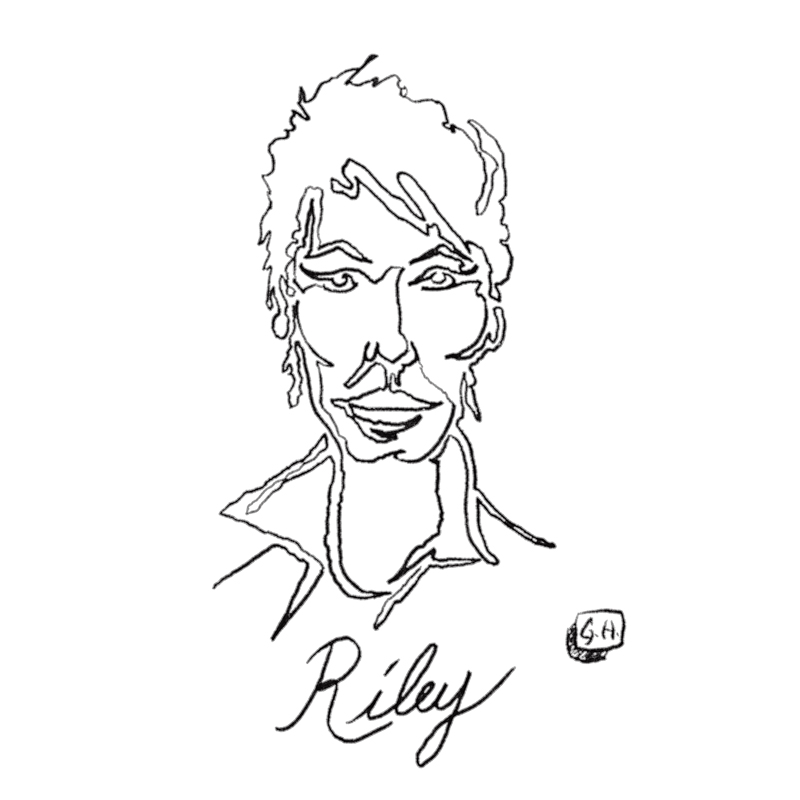
For a man with the widespread reputation as a happy-go-lucky stoner, the Boston singer-songwriter Riley James poignantly distilled the dark heart of humanity down to a few verses and choruses with impressive consistency. This hard-living, well-travelled artist penned some of the saddest songs known to North America, ones that were never quite ‘straight’ enough for mass appeal. Music business insiders however, at least those canny enough to recognize a kindred Kurtzian spirit, were simply entranced. Now, nobody claimed that James’s vocal style was technically perfect, but the fuzzy, warm growl he called singing was distinctive and he had a way of hitting the low notes that caused women to swoon and men to get angry.
A natural aversion to business dealings, typical of his kind really, worked strategically early in James’s career when he was consciously cultivating the ‘outsider’ image of an artist who wouldn’t be bought and sold like so many mocaccinos. Unfortunately, the result was that, for most of his recording career, despite a thoroughly honorable discography, Riley James didn’t have a hell of a lot to show financially for all his trouble. His irresponsibility had become a tiresome tic and he was unwelcome even in the offices of his final record label/microbrewery*.
Let’s back up a few years. Riley James’s eponymous self-produced début was good enough to attract the attention of major label publishers. Riley James featured short, sharp verses of hard-won pop wisdom in between jabbing choruses that left the listener wanting more. It seemed to come easy for him. The music press quickly fell in line, in the way they had years previously for Austin guitar-slinger Charlie Sexton, with whom James also shared a physical resemblance, insofar as they were both pretty, high-cheekboned, and full-lipped enough to be mistaken, at a distance, for women.
Expectations were high then for the sophomore album, Heathens & Heartbreakers. With a freshly inked publishing deal courtesy EMI Los Angeles (overseen by talent buyer Dean Frazier and VP Allen Barnett, who had started his career at ASCAP and wound up working for ‘the man’ just three years out of college), James swaggered into the studio swinging three solid AAA radio contenders. Even some of the ‘filler’ tracks represented serious possibilities for film and TV placement.
In order to reap greater benefits from what they thought was a sure-fire hit record, James and his manager Angie Bradshaw started their own label, also called Heathens & Heartbreakers, which they hoped would be distributed via CBS. This arrangement, minor league record company backed up by a major label publishing company, was practical and had provided many breakout artists with an avenue to success previously. But in the curious case of Riley James, it did not work and it remains a mystery as to why no-one could figure out how to put more than 50 people in room with James west of St. Louis, even as his third and fourth albums (Let It Slide and Happy Ain’t the Word), both critically lauded, stiffed.
Part of the blame, or perhaps all of it, must rest with Riley James himself. A good-looking boy, he had the motive and the opportunity and, put crudely, would simply not stop fucking anything that moved. This included his manager, and quite a few of her friends, with predictable complications and communication breakdowns. On the road, nights of oblivion and wanton sex caused no end of problems at a personal level (not to mention serial bouts of venereal disease), but ended up biting his career on the ass rather more seriously after an episode in Minneapolis when Riley hooked-up with the girlfriend of a regional AAA radio program director. Within days, sparked by the machinations of the cuckolded Twin Cities PD, a negative chain reaction among radio programmers up and down the Mississippi led to his fifth album, Dust In My Eyes, being all but removed from the Americana charts. This was particularly regrettable as Dust had recently been gathering momentum on the back of its strong title track (“Watchin’ you walk away/A part of me dies/No, I’m not cryin’/That’s just dust in my eyes”).
New managers came and went. On paper, it should have worked every time: Great albums, great production, unique sounds, chances taken with lyrics, and melodic surprises galore. Such was the regard for his musical gift, James never had trouble gathering a band or an engineer to make his mostly self-produced Lps. Yes, there were a few obvious musical allusions to past masters and the odd Beatles swipe, but who doesn’t steal the best from time to time (as James was fond of saying, “Like [The Beatles] never ripped anybody off.”)?
Despite the quality on offer, record sales were never a strong revenue stream. Nonetheless, Riley James managed to maintain deep pockets of dedicated fans. Boston and the Eastern Seaboard were basically in the bag, although he certainly didn’t help his cause by getting booted off an important Americana show in DC syndicated by NPR following an extremely hyper-active live broadcast. The show’s host, a devout Christian, convinced that James was coked up, sought to confront the singer backstage only to find him in flagrante delicto with a wily and willing female fan who had snuck in to the green room. Summarily dismissed, he waddled off the premises with his jeans around his ankles; it was both comical and pathetic. Word got around and James found himself temporarily banned from NPR nationwide.
It just wasn’t the same world out there for Riley James as it was for others. He was a man on a mission, and that mission was to get in trouble.
Once he moved to Nashville, where he had lived after following a pretty Three Faces Media intern there in 2016, his libidinous behavior only grew more depraved. For Riley, Nashville at this time was basically a pick ‘n’ mix orgy with a new crop of willing, experimental youngsters of every kind conveniently moving into town every day.
In interviews, he would smirk, but was sensible enough to be coy about his reputation; even so, he began attending 12-Step SLA (Sex & Love Addiction) meetings in an attempt to address the problem which had recently come to a particularly sordid head. James had been arrested during a sting operation at a swinger’s club that gathered in a duplex near Cinderella Studios, north of the Briley Parkway in Madison, Tennessee. In order to buy the duplex, the swinger’s club’s operators, Madison Lifestyle Hunters, had registered the property as “commercial,” which gave the district attorney a window in order to prosecute. It was a minor bust, and Riley James featured once again in The Tennessean; this time it wasn’t for a new album or selling out the Mercy Lounge, but for “illicit and immoral behavior performed in a public space.” Sometimes bad publicity is just bad publicity and with a seedy miasma now permanently cloaked around him, managers begun to give James a wide berth.
He started a final album using Pledge Music to raise the money for production. This time he decided to work with a producer and hired Jimmy “The Sandman” Rizzo who’d had some luck recently with a Gospel/Americana compilation called The Circle Remains Unbroken (Conscious Music, 2018). Rounder Records itself was interested in distributing the record, tentatively titled The Monster Under the Bed (Of the American Dream), but James had shtupped two of its reps five years previously (and left both under bad circumstances) and so once again scuppered the deal.
With his Pledge campaign, Riley James was careful not to over-extend himself, but decided to go a unique route and offer what he jokingly called “singing telegrams” for $250 a piece to those superfans who could afford it. The way it should have worked out was this: superfan (or husband/wife/partner of superfan) pledges $250 to Riley James’ new album, and when James was nearby for a show, he would schedule a time to show up at their house or office to sing a pre-determined song.
It was a great idea, but on the very first telegram delivery, just outside of Indianapolis, James showed up to sing his song “Lay It On Me” to a pledger’s wife and, caught up in the frisson of a virtually made-for-porn set-up, ended up attempting a quickie in the foyer of the family home. As if on cue, the husband showed up with their two young children, and pretty much witnessed the entire event, or at least its shuddering, sticky conclusion. Pledge Music, citing a morality clause in their contract, immediately broke off ties with James (and, of course, kept all of his money).
Finally, a bit of good fortune came James’s way when ‘Dust In My Eyes’ was placed in Disney+’s heartwarming Dog Day Afternoon prequel Puppy Morning. A surprize hit, the soundtrack album was streamed over 40 million times and because he owned the ‘Dust’ masters, James earned a small fortune, enough to retire comfortably. He took this jackpot as a chance to break the endless chain of one-night stands (in both senses) and quietly slink out of the scene while he could, to Florida.
Riley James occasionally performs at open mics in Boca Raton, where he also works part-time as a Pro Tools instructor at a local community college.
*The golden era of record-company-turned-adjunct-to-small-service-industry-oriented-business lasted a relatively short time (roughly 2012 to 2020). The likes of coffee bean roasteries and hemp clothing retailers, et al. soon found out they were dealing with a level of unpredictability and wilfulness greater than anything previously encountered. Returning to the normal shit storms associated with business (late orders, unsatisfied customers, sexually hostile work environments, etc.), they very quickly put behind them such ridiculous concepts as “SoundScan sheets”, “buzz clips”, and “artistic integrity”.

 Americana Unsung