T. Edward and Prince Asbo are retired critics living in Rockville, Maryland with their pet Welsh Corgis named Danko and Manuel. G. Hage lives in North Carolina, USA where he done all them purty pitchures. P. Asbo assembles the collages, as needed.
‘Blind Thomas’ Jefferson b. Clifford Jefferson, Ada, Ohio, 1939.
Famed music producer Sam Phillips reputedly said, ‘If I could find a white man who had the Negro sound and the Negro feel, I could make a billion dollars!’ But the Sun Records impresario could have in no way been thinking about the pale Ohio blues aficionado Clifford Jefferson, aka ‘Blind Thomas’ Jefferson, whose well-meaning, if ill-conceived arrogation of the African-American art form only just bordered on the mediocre and whose purported visual impairment was a wishful pretence cut almost entirely from whole cloth.*
The history of American Caucasians culturally appropriating from their black countrymen is a long, vaguely (sometimes downright) racist, and, for the hundreds of thousands of white people affected, slightly uncomfortable one.** And in this way, romantic notions of black ‘realness’ and ‘authenticity’, so widespread among suburban whites who only experienced African-American musicians mediated via fawning magazine articles and documentaries, consumed Clifford Jefferson. He set out fervently at age 18 to be a ‘real’ and ‘authentic’ blues artist during the Folk Boom of the late-50s, sharpening his craft for no less than 10 years. Sadly, Jefferson plateaued within the first 90 days of his quest, so that the net result of a decade’s worth of diligent practice was effectively three months’ experience 40 times.
With none of the drive of Chicago Blues or rhythmic subtlety of Country Blues, Jefferson’s technique allowed one true innovation, the 13-bar blues form, which, alas, only succeeded in confusing any musicians unlucky enough to accompany him. And far from the cathartic experience usually associated with the blues, Jefferson’s music conversely made people feel more depressed than before they’d heard it.
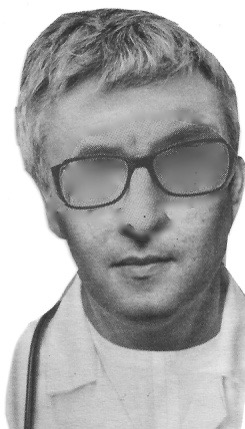
For such a little-known musician (there’s only one known photo extant, above), Jefferson is said to have brushed up against several major blues artist of the time and performed for many of them as they toured the US, though to little avail professionally, e.g. Canned Heat paid him $125 not to open for a 1968 Cleveland Music Hall gig. More recently, an Internet rumour (likely apocryphal) held that Jefferson traveled to the infamous Clarksdale, Mississippi crossroads in search of guitar mastery only to have the Devil turn down the proffered soul, Ol’ Nick deciding that it wasn’t worth the trade.
Clifford Jefferson released only one record during his career, the autobiographical ‘Palindrome Home Blues’ b/w ‘The I, IV, V, VI Blues’ through Arsehoolie Records in 1969 on thick 78rpm shellac, no less.*** After this, he seems to have quickly vanished.
In a career marked by squandered white privilege, ‘Blind Thomas’ Jefferson did manage to exactly emulate his obscure blues heroes insofar as few, if any, will remember him or his music; a moral victory of sorts.
*In order to appear blind, per some of his musical forebears, Jefferson affected glasses with extremely thick lenses making it nearly impossible for him to see to walk let alone what chords his hands were forming. He did, however, suffer from a slight astigmatism.
**Which is precisely why US conservatives are so right to try and protect their fragile cohort from awkward facts suggested by Critical Race Theory, Beloved, The Color Purple and Inventions and Inventorsby Roger Smith.
***Jefferson had originally insisted it be issued as a wax cylinder, but this proved too costly. And insane.
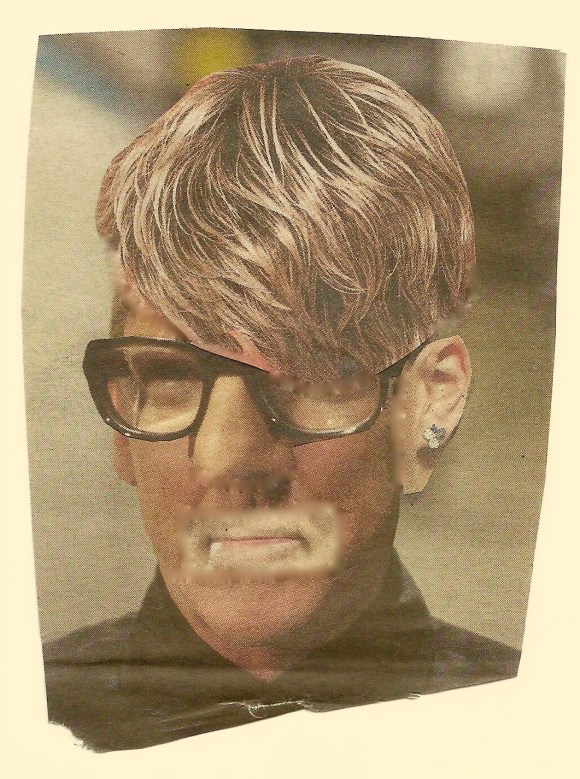
TKATA The Gay Farmer (pictured) b. 1987 Franklin, TN, d. 2019 Austin, TX; Ginger Minge b. 1984 Minneapolis, MN
Art school brats formed satirical bands all throughout the rise of the East Nashville Americana scene in the 2000s, existing in a parallel universe of japes and outrage. By design, these merry pranksters were built for little more than house party fun, and few expected to achieve anything else. There was, however, one band, the ever-so-charmingly named The Kunt and The Aids*, who briefly broke out among the scores of flannel-clad beard-wearers earnestly strumming 6-string banjos and Tenor guitars.
This “mock-folk” duo, inspired by fellow smut-peddlers and country music freaks Birdcloud, used a Fun Machine keyboard, Ovation guitars, and vocoder drenched harmonies to compose hickified sing-a-longs about bestiality, the joys of revenge porn, public defecation, and other topics Willie Nelson was too chicken-shit to tackle. Their twisted, cornpone ditties were as catchy as an airborne virus and twice as funny.
Both band members were absolutely devoted to their outrageous personae. Pete Gaston, aka “The Gay Farmer,” was known to wear a tutu with overalls on stage, while the ever-unpredictable “Ginger Minge” (born Thomas Edward Grovitz) regularly appeared with dildos and VagiPals festooned to his outfit. Unafraid of cheap onstage shock tactics*, the band garnered headlines that only the best faux scandal could generate.**
Despite a devoted underground following from coast to coast, and a decent European following to boot, a band called The Kunt and The Aids singing songs called “Flag Slut” and “Dick Pics (From Hell)” was never going to appear on The Tonight Show or Good Morning America. But Social Media and the Internet is tailor-made for such provocations and TKATA (as the trade magazines were forced to call them), whose followers numbered in the 15 to 20 thousand range according to SoundScan, more than made due playing hundreds of well-paid, PBR-soaked gigs in the clubs and houses of their devotees. Their début Lp, I Married A Teen-Age Nazi (Bludinstule Records, 2017), boomed out of college dorm speakers for a good part of the late teens, even if at least half of those listeners missed a good deal of the irony.
Alas, the fun wouldn’t last. In 2019, Gaston was arrested for assaulting a Spotify Podcast Sales Specialist during a SXSW after-show. Speeding away from Travis County Jail after making bail, he crashed his powder blue Subaru Forrester into a guardrail on Interstate 35 while swerving to avoid colliding with an oncoming driver who was texting her husband about a mis-ordered vegan pizza. The Subaru ended up rolling several times down an embankment into a piece of construction equipment, impaling Gaston’s torso on the stick part of an electric washtub bass that he had built in art school. He died. The other driver was charged with vehicular manslaughter, but was acquitted largely, it seems, because the defense kept repeating the name of Gaston’s band.
Back home in Music City, East Nashville was in mourning. Another legend gone. Without telling a soul, Grovitz moved to Reno to study nursing. He has never played another note.
* According to Grovitz, The Kunt and The Aids got their name “because our first choice, Painful Discharge, was already taken by a Columbus, Ohio punk band from, like, the 80s that had a few records out, and because my dad thought that [TKATA] was was the most disgusting name for a band ever, and ‘Don’t you dare call your band that.’ So, of course, we had to at that point.”
** Perhaps the band’s most notorious onstage stunt occured at the 2017 CMJ Conference in New York Citywhen Grovitz, dressed as Little Bo Peep, was mounted from behind by Gaston in a lamb costume during a performance of an exceptionallly gross “The First Kunt (Is the Sheepest)”. Some people have suggested it was the reason for the music events/media company’s demise that year.
***Another amusing story involved ‘prepper’ food bucket shill Jim Bakker referring to the band, by name, during one of his already deeply weird broadcasts. The group were performing in the same town as the disgraced televangelist and, dismayed by their antics but tricked by the misspelling of the word ‘cunt’, didn’t quite realize what he was saying when he announced on air, “I pray for The Kunt and The Aids”. The band gleefully projected looped clips of Bakker’s gaffe onstage for the rest of its career.
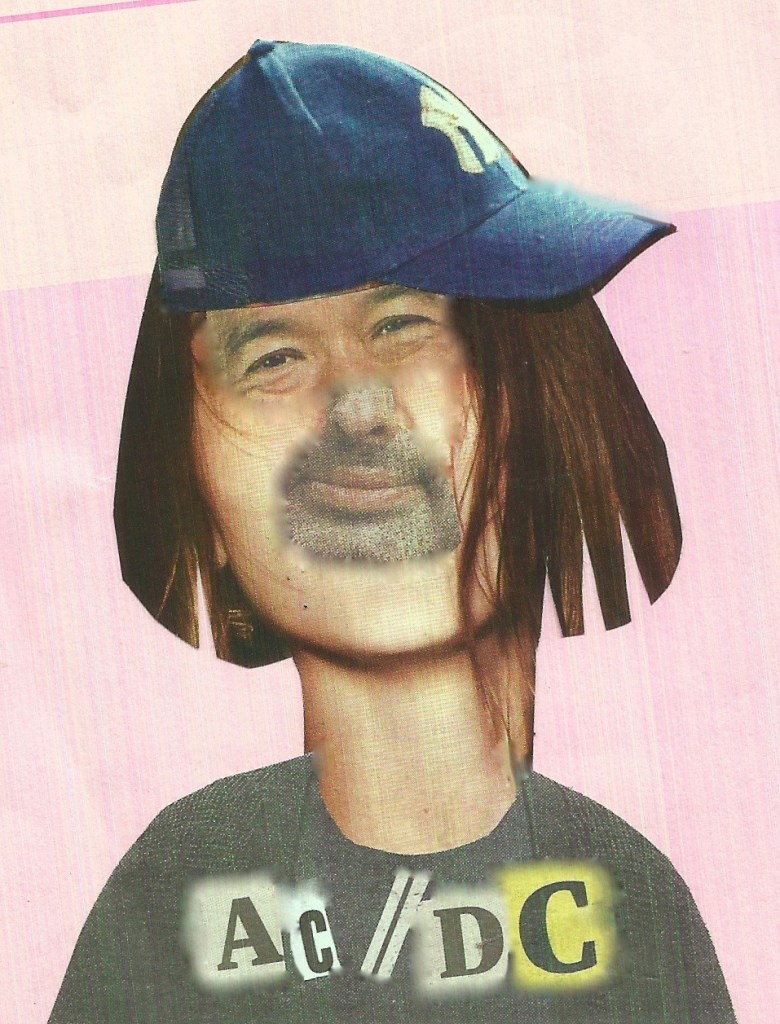
Bocephus Junior (active 1979-1980), Monticello, Ohio. John Mannfred – drums; Don Mount (pictured) – electric rhythm guitar; Jody Stout – electric lead guitar, backing vocals; Eric Weissman – bass guitar, lead vocals.
In the 1970s and 80s, there was, of course, no such thing as ‘Americana.’ There was, however, ‘Southern Fried Rock’. Pretty much any small town south or west of Massachusetts was host to six or more pedestrian bar bands specializing in humorless, unswinging Lynyrd Skynyrd/Marshall Tucker Band/Allman Brothers covers, which, if an audience was drunk enough, didn’t sound enough not like the originals to pass. Bocephus Junior was one such group.
Formed in part for the purpose of hanging out and pounding brewskis in guitarist Jody Stout’s basement while nominally rehearsing, these high-school seniors at least partially made up for a lack of imagination and chops with a winning lack of pretence and sense of fun; their parents and girlfriends were supportive and all was good.
Typical of most other high-school bands, expressions of hitting the big time, the designing of band logos, and the naming future albums featured as prominently during their rehearsals as did the actual playing of music. Per the fashion at the time, all four members wore longish hair parted down the middle, which they covered with baseball caps adorned with sports teams or the trademarks of local businesses, worn unironically. Don and Jody could even lay claim to moustaches, however wispy. Eric sometimes sported a blue F.F.A (Future Farmers of America) jacket with its distinctive gold stitched emblem on the back. (His friends would make fun of this look, calling Eric a ‘Future Fuckhead of America’.) Boot cut or flared Levis, black t-shirts obtained like trophies of war at deafening concerts in Columbus and Cleveland emblazoned with the iconography of various hard rock bands, and tennis shoes of different shades completed the outfit.
They’d been playing for several months and even notched a few afternoon gigs under their belts at indulgent downtown Monticello, Ohio bars when an opportunity arose to play at the band’s high-school talent show. It was a high-profile show locally: the high school administration and staff, the school board, and other Monticello grandees would be present, not to mention all of their high-school buddies. So the band was especially conscious that putting on a good show would be important. Agreeing that Lynyrd Skynyd’s anthem ‘Free Bird’ was exactly the showpiece with which they could regale a 900-strong Ludlowe Theater audience, Bocephus Junior woodshedded harder than they’d ever done. They were proud of the results, which were, to be fair, at least credible.
The band would be one of the last acts to perform, so it was going to be a long night. Backstage jitters were calmed with a large bottle of MD 20/20 White Label (gulped surreptitiously in the alleyway behind the Ludlowe) and general joshing around. Among a variety show-style bill, Bocephus Junior was the only band to play that night and an air of aloof cool, along with the Mad Dog, coursed through their bodies.
Then came the unexpected, potentially catastrophic news that the three-hour show was running late.
An entertainment licence lasting till only 10pm broached the very real possibility that the band’s very spot on the bill was in jeopardy. This was a fate they’d never even considered. Shortly, performers were being asked to truncate their acts. Bocephus Junior was told they’d have to edit out the entire extended jam section of ‘Free Bird’.
“That’s total bullcrap, man,” Mannfred said angrily to Mrs. Potts, the MHS science teacher and stage manager for the evening.
“Any more talk like that,” replied Potts firmly, “and you’ll be out of the show altogether.”
The band was not happy. Two months of honing their performance to perfection down the toilet because of some half-assed magician, a Benny Hill impersonator, and whoever the hell else it was in the first act that couldn’t watch a clock.
Drastic measures were called for. A quick huddle led to a significant change of plans and fifteen minutes later, with the courage that comes with shooting a bottle of fruity 18% ABV fortified wine, Bocephus Junior hit the stage like they were expecting to be hit back.
“ARE YOU READY FOR A BJ?” yelled Stout into his mic, then pausing for dramatic effect. “BOCEPHUS JUNIOR, GEDDIT?”
The crowd gasped. Educators shifted nervously in their seats, while the teenagers, mouths agape, laughed and whooped.
“We gonna do an old song for y’all!” Stout carried on, only slightly less shouty. “It goes a lil’ somethin’ like this!”
And with that, he and Weissman launched into a scatological version of Dan Emmett’s ‘Ol’ Dan Tucker’ that they’d composed together in grade school when Weissman played the author of ‘Dixie’ in a school play called ‘Dan Emmett As a Boy’.
“Old Damn Fucker was a shitey man,
He warshed his face in a garbage can,
He combed his hair with a piece of glass,
And died with a toothache up his ass.
So git out the way, Old Damn Fucker,
You’re too late to stay for supper,
Supper’s over, breakfast startin’
Old Damn Fucker, shittin’ ‘n’ fartin’.“
As the song concluded, Mannfred and Mount kicked over the drum kit for good measure.
Pandemonium ensued.
The younger half of the crowd was literally going wild, racing up and down the aisles shrieking, while teachers and parents chased after them in vain. Mount boomed, “ROCK AND ROLL!” into the microphone as the band strode off the stage, heedless to the mayhem they’d caused.
Obviously, a price would have to be paid for their recklessness and sure enough, all four members of Bocephus Junior were suspended from school for three weeks and told they were lucky not to be expelled. In addition, rock groups were forever banned from the school’s talent show. It was just the kind of outlaw comeuppance upon which legends are based.
Despite the publicity, Bocephus Junior really weren’t good or interesting enough at that stage to parlay the notoriety into any kind of meaningful career momentum and broke up without fanfare shortly after graduation. Later, Mannfred, Stout, and Weissman formed a regionally popular hardcore punk band called StröhBraü while attending the Ohio State University, releasing a 4-song ep on Whatever Records called Last Train to Shitsville (1986).
The New Dylan (b. Carter Jensen, 1995, Charlottesville, VA)
As a lazy rock critic appellation, ‘The New Dylan’ has been distinct less for accuracy or appropriateness and more as a marked curse on its recipients. Down the ages (at least subsequent to the time in the mid-60s when Dylan became ‘Dylan’, necessitating the clamour for a new one), scores of literate, earnest singer-songwriters have been dubbed ‘The New Dylan’. And while a goodly number of these have been decent or even excellent musicians, none, with the possible exception of Bruce Springsteen, has approached the musical or cultural significance of the namesake.
Christened with a perfectly serviceable ‘Americana’ name, Carter Jensen chose to provoke the ire of the show biz gods by selecting a stage name seemingly begging for failure. That he compounded his error by making a baffling satirical concept album as his début demonstrated an appalling lack of judgement buttressed by almost Orson Wellsian self-belief. Sadly, Jensen didn’t lack talent. At least that would have made his short-lived music career more comprehensible. In fact, Jensen, who retained a look that combined the Millennial hipster with a 90s boy band member, was a too-clever-by-half prankster whose obscure in-jokes simply went over and around everyone’s head.
From an early age, Jensen was a prodigious smart-ass. While this earned kudos from classmates, his teachers were far less understanding. During his third grade year, for example, Jensen spent virtually every night in detention for one transgression or another. By the time he was in eighth grade, he was publishing a well-observed and bitingly harsh blog (“Eat My Ass–It Tastes Like Chicken”) based on his experiences and observations of Middle School life. Somehow, Netflix caught wind of Jenson’s work and optioned it for a series. A pilot episode for the series, tastefully shortened to It Tastes Like Chicken, was filmed with Asa Butterfield (The Boy In the Striped Pyjamas, Sex Education) as ‘Carter Johnson’, but a full series was not commissioned. Nevertheless, a substantial sum of money from the option was put into trust for when young Carter came of age.
In the meantime, Jensen took up the acoustic guitar and begun to investigate the ‘old timey’ music of Harry Smith’s Anthology of American Folk Music. Its manic energy, cleverly veiled sexuality, and muscular surrealism appealed and contrasted with the heavy irony and banal brutalism of contemporary pop.
There exists a folk clique dedicated to the ‘old, weird America’ around the University of Virginia, where Jensen, as a junior in high school, was taking advanced placement English courses. It was at this point, while hanging out with the bewhiskered, bespeckled, real-ale drinking academics of UVA, that he began formulating what would become his ‘The New Dylan’ persona.
Unlike many musicians of a folky bent, Carter Jensen never really fell for the music of Bob Dylan. He was something of a purist and regarded Dylan as a ‘popularizer’ who stole lyrics and themes from ‘genuine’ folk artists. Still Jensen recognised the great man’s career arc as ripe for parody. Unfortunately, his didn’t recognise the severely limited appeal that such satire might have in the 2010s, however well rendered, and heedlessly ploughed through his considerable Netflix money to finance the production of an audacious Lp, The New DylanHas Arisen (2017) on Thirty Tigers (who really should have known better), based on the life and career of the erstwhile Robert Zimmerman, carefully aping the style of each era.
The song titles effectively tell the story:
“This Song Is My Song (This Song Is Not Your Song)”
“Moan Baez, More Like”
“It Takes An Electric Guitar To Make Pete Seeger Cry”
“I’ve Got Those Contract Breaking Motorcycle Crash Blues Again”
“Big Stink”
“Self Parody”
“I Hate My Wife (But This Song’s Not About Her)”
“Shilling For Jesus”
“Knocked Out Another Album”
“Frog In My Throat (For 30 Years & Counting)”
It was a bold move, but the jest quickly soured. Most of the prospective audience was completely turned off, believing the title a serious boast. Casual music fans were thoroughly nonplussed, regarding the album as simply peculiar. It effectively ruined any hope of a job in the music industry. Another proposed song-cycle, this one based on an imaginary meeting between Buck Owens, Roy Clark, and Jack T. Chick (provisionally titled Haw Haw), never materialised, nor did plans to rebrand himself as folk-rapper Nude Illin’. Shortly following the debacle, Jensen quit playing guitar altogether.
Jensen later worked for a short time as an assistant showrunner for The Simpsons, before his well-observed and bitingly harsh blog about the experience (“Not As Funny As It Used To Be”) got him fired.
In an interesting twist, Bob Dylan himself has been known to perform “Frog In My Throat” during rehearsals.
Georgia’s Stone Mountain’s infamous laser show is one of the most fascinating and disturbing uses of light amplification by stimulated emission of radiation technology to honor men on the wrong side of history. The program starts off, harmlessly enough, with the lasers rendering a full portrait of Ray Charles as his exquisite rendition of Hoagy Carmichael’s tribute to the Peach State plays over the speakers stretching across the massive field in front of the mountain. The next sequence is more troubling. Lasers ‘finish’ the world’s largest pro-inequity bas-relief monument by ‘drawing’ legs on the torsos of the horses underneath the 190-foot wide rock depiction of Robert E. Lee, Jefferson Davis, and Thomas “Stonewall” Jackson. Thus animated, the lasers then heroically ‘march’ the Rebel leaders off the side of the mountain, as “Dixie” blares from the PA system.
One night back in ’88 as the Pink Floyd-esque version of General Jackson marched off the mountain to that Yankee-written Confederate anthem, Hank Jackson, completely loose on the handful of mushrooms that his girlfriend, Sadie Mae Buckley, had supplied, swore that the old general looked him straight in the eye and uttered the words, “I command you to make me a son.”
As cheers rose up from the crowd, the couple wandered off to the nearby woods. Putting strange psychedelic experiences aside, the University of Georgia computer science major took his partner of only four months out into the bushes to do what college kids will do.
Hank Jackson was not a racist man, and unlike many of his Polo wearing Fraternity Brothers, he was quick to shut down any racist comments within earshot. But he came from a Southern family that had distant relatives who had fought for the South in the Civil War, and some not-too-distant relatives who may or may not have gathered in Klan robes at the foot of Stone Mountain in the early part of the 1900s. He was another example of a boy who grew up with actual Klan members in his family, but was able to break the chain of hatred through the love and education of good parenting.
Despite this, Hank Jackson chose for the son conceived that night an unfortunate and ill-judged middle name. Still reeling the next morning, he promised the spirit of the notoriously stubborn rebel General who was accidentally shot and killed by his own men at the Battle Of Chancellorsville to name his son in “Stonewall”‘s honor. Nine months later, as he wrote ‘Moses Stonewall Jackson’ on the birth certificate, Hank had apparently not reconsidered; whether it was mischief making or something more profound at that point, we’ll never know.
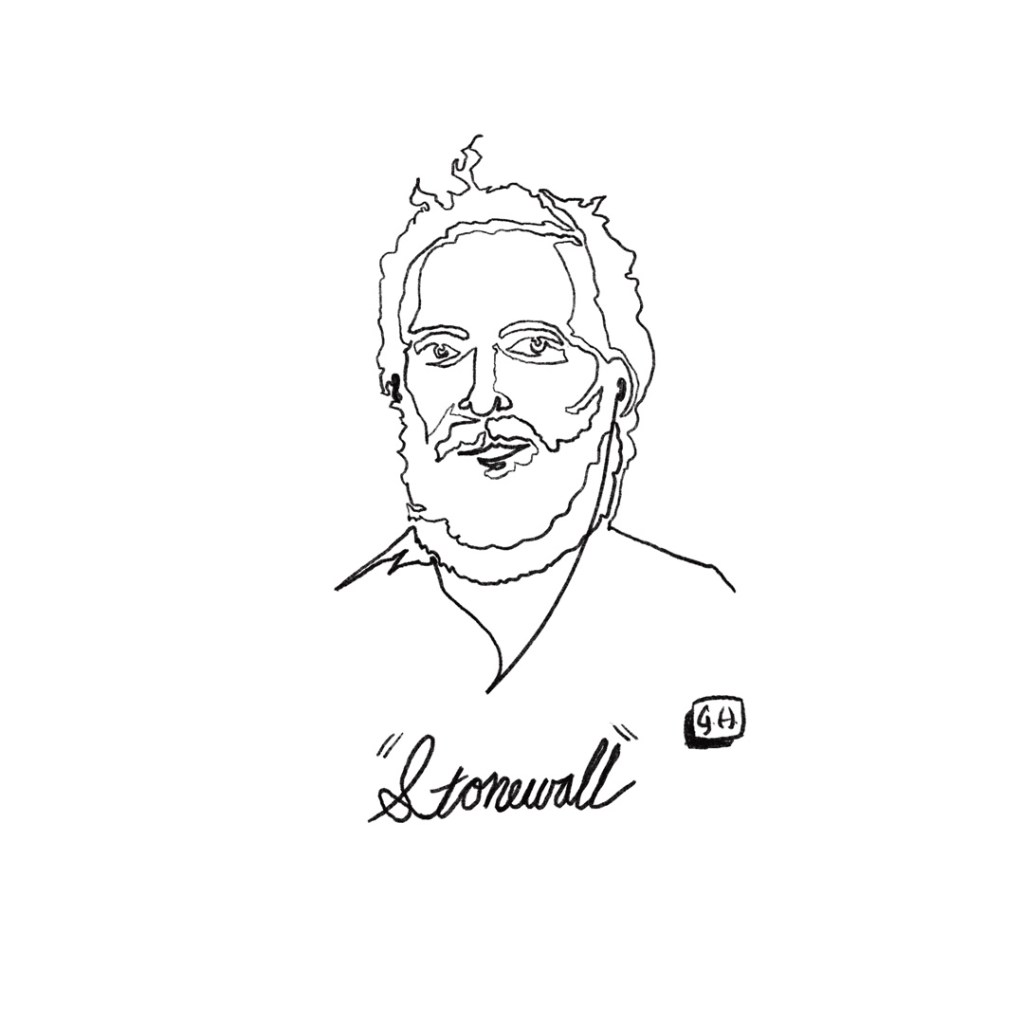
Moses Stonewall Jackson was sensitive enough to dislike being called by his middle name. He has since been called plenty other things: poet, picker, magician, workaholic, vandal, vagabond street musician, and respected songwriter. Jackson has also been known as a bush pilot, an Alaskan recluse, and founding member of the renegade activist organization Wander The Woods. These days, he is a prophet or a terrorist, depending on which side of the political coin you toss. Either way, there can be no doubt that he is the greatest overachiever in the contemporary Americana scene.
After growing up in the furiously independent and artistic Athens, Georgia music and art scene, Moses, who managed to keep his middle name out of the press for as long as he could, ended up becoming a prolific and talented creative. His parents, who remained in Athens after finishing college, opened a coffee shop and proceeded to curate one of the finest vinyl record collections in town; which you could peruse and spin at their shop.
Moses started writing songs early; creating “albums” of cassette recordings he had made at home using his parent’s stereo. In his earliest days as a budding songwriter, Jackson’s modus operandi was to write a bunch of titles and then just write songs to go with them. These cassettes have so far never been released, but somewhere is a plastic tote full of these early, inchoate projects. Before Jackson had finished high school he had actually released his first album, AnotherCreek Bank (2007), under the name Bright & Broken. The record came out on vinyl-only (of course) thanks to some like-minded friends in the Platypus Seven Collective that had also released albums by The Broken Bridges, On My Bastard Knees, and other local singer-songwriters who hid behind band names, as was the fad at that time. No legal documents were ever signed, with the understanding that creativity was not to be stunted in any way through contractual tombstones.
After his début seeped out, Moses Jackson did not hang around for any public acknowledgement. Instead, he bolted on a backpacking trip to Europe where he busked streets from Dublin to Barcelona, oblivious to the gathering tide of praise back home. AnotherCreek Bank started to get passed around college radio, who never waited for someone to tell them if something was relevant or not.
Meanwhile, through various college connections and tech savvy music geeks, the internet started to buzz about Moses Jackson. Not much was known about him, which added to the allure, and soon ‘genius’ rumors began circulating.
Pitchfork sang hosannas, saying Jackson’s songwriting “…heralds a new form, where lyrical explosions match the sonic surprises.” The word eventually wung its way across the Atlantic to Madrid, where Jackson had taken up residence at Casa del Musica Acoustica, a folk and jazz club that paid him in hashish and Paella.
Clearly en route to major independent labels and such, Jackson returned to North America to assemble a band that went on to tour the Continental US in a Black conversion van he christened the “Sweet Black Angel,” after the Rolling Stones’ 1972 tribute to political activist Angela Davis; he immediately wrote and recorded “The Ballad Of The Sweet Black Angel,” an ‘aw-shucks’ tale of North American van life. He went on to woo both coasts, not to mention the heartland, before getting dropped by 3 different managers and as many booking agents and publicists simply because he could not stay in the present and support the album he was ostensibly touring.
The sleeve of the first full-length album under his own name, Moses Jackson Destroys The Past (2008), featured a picture of the cherubic singer on the front with naturally messy hair tucked underneath a Greek fisherman’s hat with his big, youthful, optimistic eyes on full display. It was an instant hit with college DJs. He had the proverbial old soul, and in the face of the widespread cynicism that came with the punk rock ethos still rampant in indie music, there was an idealistic force to the lyrics so forcefully belted out on top of all of the nihilism that the music may have implied. Drums machines, horns, samples–there was nothing off limits, and Jackson was not lacking in confidence when it came to singing, something that went against the grain of the mumbly, echo and reverb soaked vocals that were taking place around the edges of incoherent vocals and weak lyrics scenes that flourished in post-REM Athens. With the advent of cheap synths and reverb units, combined with remarkable sampler technology, Jackson went against that particular grain with thoughtful, enunciated lyrics; nobody had to guess what words he was singing. Even if they did not appear to form a cohesive story, you could tell he was actually reading literature.
The problem, if you want to call it that—and anybody other than Prince trying to make a dent in the music business would—was that Jackson was simply unable to cease creativity long enough for the public to catch on to any single composition. By the time he reached the West Coast on his first tour, backed by a trio of worthy musicians from Athens, he had composed an entire new album’s worth of tracks. To make matters better or worse, he also not only assembled demos of these tunes through late night workaholic sessions in Red Roof Inns across the nation, but he also insisted the band play the songs live. The “old” songs already felt rusty to him, and there was a new vibe around every corner. As the band progressed up the West coast, they popped into Jackpot Recording Studio, owned and operated by Larry Crane, who also ran Tape Op magazine, and who had recorded a young Elliott Smith, a hero of Jackson’s. During a one day marathon session, the band recorded 13 new songs, 9 of which made it to his second album There Is Another Way, the rights to which he promptly signed over to the Olympia, Washington indie label Kill Rock Stars before the mixes were even done. With the promise that they would print and release the vinyl within three months of that date, and of course pay the studio bill. This time there was an actual contract, but nobody actually read it.
The word was out. There was another superstar on the rise, and the critics and the super fans came crawling. The major labels did too, but were sent packing after they realized that, as John Lee Hooker had famously done years before, Moses Jackson was constitutionally incapable to fully comply with or understand the subtleties or basic realities of a legal document, and would record and release albums willy-nilly, at a frightening pace, whenever and wherever he could. So for example, only two days after signing the Kill Rock Stars contract, Jackson recorded two songs at the apartment of songwriter Pete Krebs in Portland, which he then sent via cassette to the ultra-indie Okra Records, based in Columbus, Ohio, who promptly printed them into a 7 inch record. Two days after that session, while in Seattle, Jackson visited the offices of Sub Pop records where he verbally agreed to a project that never came to fruition after Kill Rock Stars label owner Slim Moon, in possession of the still wet, yet somehow meaningless contract, called Jonathan Poneman of Sub Pop and explained what was transpiring with the explosively creative troubadour.
Friends and casual acquaintances all tried to sit Jackson down and explain how lawyers and contracts worked but it was going in one ear and out the other. Both ears, incidentally, were often covered by headphones, as he was constantly listening to or working on demos. He was on a mission to sabotage the norms of creative output, and then he finally met his match, or his spark, so to speak.
The weekend following the sessions for the Kill Rock Stars LP, the band played two shows in Seattle. Jackson met a young poet and visual artist named Stormy Vanderark from Palmer, Alaska. Stormy was to alter his path considerably. The band was set to drive back to Georgia when Jackson suddenly decided to not go with them and instead follow his new friend up to Alaska where she had promised him a unique adventure. The two of them, along with a young Malamute dog named Huckleberry Funn, crossed the Canadian border in her Subaru Outback and made their way through the Yukon and into the Matanuska Valley, falling deeply in love along the way.
Once in Alaska, the Vanderark family fascinated Jackson. Stormy’s father Cyrus was a deeply Christian master carpenter, while her mother Rosetta was a superior woodworker, who also created sculptures out of found objects. Rosetta Vanderark reminded Jackson of his own maternal grandfather, Henry Moses Buckley Sr, a Vietnam Vet who welded sculptures out of old car parts and created art that filled his two acre lot just outside Leipers Fork, Tennessee; he had once hosted the songwriter Leonard Cohen for three days of Transcendental Meditation, Yoga studies, and welding lessons. The Vanderark compound, in the village of Sutton, just outside of Palmer, Alaska had 360-degree views of the Chugach and Talkeetna Mountain ranges. They were also just a short drive from Hatcher Pass, a glorious passage through the Chugach range that appeared to be right out of a Tolkien novel. In fact, the whole Vanderark vibe was one of creativity and art from the way their house was built, their garden, the animals, the magnificent mangers they built for the animals, and the constant push towards self-expression and radical gardening. They made their own clothes, and they made their own music, heavily steeped in denim, corduroy, and old-timey folk tunes respectively.
He and his new love were creating together as well. He worked on lyrics and songs, and she worked on designs for merchandise such as shirts and bags and necklaces made out of old guitar strings and stones from the creek. The Vanderarks had plenty of room and use for a new able bodied man around the compound, and Jackson learned the art of macrobiotic cooking and doing hinterland chores such as chopping wood, Northern climate farming practices, and feeding the horses and goats.
Jackson stayed on as long as his restless mind could handle, but as the winter 2009 approached he decided to part ways and returned south for Christmas in order to tend to a few personal items such as attempting to pay his bills and also to resume communication with his own family, who had grown somewhat concerned with his radio silence. He was, after all, spending time in a place where cell phone service wasn’t reliable, and nobody cared about posting photos of their latest meal (which, in no way possible, was as good as the fresh Alaskan Salmon, Moose, and Caribou meat that Jackson was enjoying in the North).
Once back home, Jackson grew increasingly irritated with his old, slow moving creative community and their absolute reliance on social media. Jackson himself had been highly addicted, posting regularly on Instagram, Twitter, and other creative hubs. He was known for chronic over-posting, further driving independent record distributors insane with his constant flow of new music, often posting songs the day he wrote them, without much thought or editing; they would garner thousands of hits right on the very week that Jackson had released an album that distributors were trying to sell at media outlets. A lot of hair was pulled out but what could they really do?
The advent of the Tik-Tok fad was one login password too many for Jackson, and he famously tossed his iPhone out of the window of a moving van as it crossed over an interstate bridge outside of Atlanta. His new bandmates just laughed at his recklessness, but then that same night, when they were set to headline a high-paying New Year’s Eve gig at a private farm in Douglasville, they were unable to communicate with their lead singer, who had wandered off into the woods when he was supposed to be on stage.
This was just too much for his backing group, pulled together from among the few remaining Athens musicians who either didn’t want to kill Jackson or steal his gear to help pay themselves from past tours. When they encountered him a few weeks later, he was unceremoniously chewed out for his foolishness and inconsideration. He copped to it, admitting that he had met “a new friend” who drove him off in the night. Moses Jackson was due for a reckoning, and it came in the form of his band mates and flatmates unceremoniously kicking him out of their shared house. He was not welcome in Athens for a period of time, and although there was always some sad eyed lady of the lowlands or other who would take him in, he grew evermore nonchalant about all things related to his career and social media, and so one day without warning he hit the road for Alaska again.
Arriving in Spring and promptly showing up at the Vanderarks’ door, nobody batted an eye as they welcomed him back into the fold. Stormy, who was more independent than any woman he had ever met, cared less about what he had done in her absence, and more about what he was going to do now that he was back. In her opinion, humans were free to act as they wished as long as they could handle the consequences, something that Jackson was slow to pick up on.
Before long, the two of them had begun work in building their own cabin on the property of the Vanderarks. By mid-Summer 2010, Jackson had home recorded enough tunes on a cassette four track to print another album. Backing vocals were provided by the Vanderark Family and the songs took John Prine’s old maxim of “blow up your TV, move to the country,” etc… to a new level. Jackson named the project The Valley Below. These were folk songs about destroying Social Media and all or anything related to the old South, but sung with a folksy, family band vibe. One of the songs, “Dead And Gone,” a scathing report on all the sculptures of Nathan Bedford Forrest that dotted the American South, featured the lyrics:
“If you vote to keep Nathan’s sculpture in your Statehouse capitol/we will hunt you down, and put you in the ground.”
This was Woody Guthrie and Phil Ochs on steroids, and when the press got wind of the lyrics they immediately focused on Jackson’s given middle name, causing him enormous amounts of embarrassment. The press also quoted, and deliberately misinterpreted, the controversial lyrics to both “Sweet Black Angel” and “The Ballad of….” In his over-sensitive and defensive mind, he had no option but to answer his critics (now mostly bloggers since major websites such as Pitchfork had ignored him with every project since There Is Another Way.) with another song cycle that attacked the three figures of the Stone Mountain monument, and especially his namesake.
This time, any label with actual distribution was out of the question. These new projects were completely independent and released on Bandcamp only. Jackson claimed he didn’t want to press vinyl because of the environmental damage that vinyl manufacturing houses were causing, but the fact is he couldn’t get anybody to print the vinyl. The majority of the merchandise was based on fashion and poster art created by Jackson and Stormy Vanderark. A very small vanity label from the region, Hatcher Pass Records, started by the songwriter Matt Hopper, offered to press vinyl for one of the four albums Jackson made while studying for his bush pilot’s license that year. Jackson conceded because the pressing was to be very small, only 250 copies, and they would hand paint each and every one of the covers, all using recycled Lp jackets they bought in an Anchorage Salvation Army Thrift Store. Unfortunately, Hopper and Jackson’s relationship soured after Jackson released the Bandcamp only Lp Trustworthy Pilot (2012) on the same day as Hatcher Pass released The Value Of Your Word (2012) on vinyl. Both albums were praised by Guided By Voices frontman Robert Pollard, who surely recognized a kindred spirit in his prolific fellow creative soul.
Already an outsider, Jackson became estranged from even independent society. He was literally out on the fringes of small town Alaska. The lack of sunlight and daily ingestion of THC infused gummies had an impact on the normally hyper-creative Jackson. He found himself unwelcome at house concerts and songwriter nights in Anchorage; his beloved Stormy could not slap him out of his self-centered rants. He began to read more and write less. He read all the words and journals of Edward Abbey and Che Guevara, the El Salvadoran poet Roque Dalton, The Unabomber’s Manifesto, and plenty of other anti-establishment literature. He began to feel there was no way forward for his thoughts on social media and began to lose followers by the hundreds due to his increasingly violence-stoking rants about burning down the system and starting over again.
He would wander into Vagabond Blues, a coffee shop and folk listening room in nearby Palmer, where he would obsess over the internet–his only connection to independent music being made in the lower 48. He would often post a dozen or so consecutive rants on various sites. He began hash tagging his rapid-fire posts #WanderTheWoods or #TheQuietPath. Jackson would spit vitriolic responses to anybody who compared him to Christopher McCandless—the romantic and very much dead wanderer who became a hero because of the book and film Into The Wild (2007) which documented his nomadic descent into tragedy. “That idiot went out into the woods and died,” Jackson was known to say. “I can actually read maps and understand how rivers work,” he would taunt those that considered McCandless a hero.
Within a year of his arrival to Alaska he had burned too many bridges to count and was forced to move into a cabin in Moose Pass, on the Kenai Peninsula. From there, he began to make the plans that would shock and enthral the nation, earn him countless new admirers, and not a few enemies, and propel him to a whole new level of folk stardom.
Unbeknownst to the Vanderarks or most of his family back in Georgia, Jackson hatched a two-fork attack plan in regards to destroying or defacing Confederate Monuments. His first attack was simple and direct. He schemed to vandalize the statue of Nathan Bedford Forest that lays on a patch of private land just off Interstate 65 as you drive North into Nashville. There was a fever in the land among racists with the re-election of the nation’s first black president, and during the same period, the group, which by now was off the internet completely and only relying on hand-written letters, hatched a plan to drop as many gallons of pink and black paint as they could carry onto the very relief sculpture that gave Moses Stonewall Jackson his middle name. Unfortunately, the FBI, who had been monitoring Jackson for several months at this point, foiled his plans at zero hour, apprehending three of the four vandals as they attempted to ascend Stone Mountain with rappelling ropes and plastic containers of paint.
Jackson got away, however, and retreated to Alaska. None of the three apprehended vandals gave up his whereabouts and all were released due to no prior convictions. The Vanderarks refused to let him back on their land. It was not because they disagreed with his political stance. They simply did not want the press or, worse, copycat radicals to seek him out there. Some say he has moved to Idaho, and others say he returned to Tennessee. Either way, the most common speculation, based on his own manifesto, published before closing all his social media accounts, and the thing that got the FBI to monitor him in the first place, is that Jackson is currently part of a small, off-the-grid communal farm where members are forbidden to have smart phones. There is further speculation that Jackson has renamed his group The Way, or The Quiet Path.
Wander The Woods was taken off the FBI list of terrorist organizations since no further evidence was brought forth regarding their activities since August 2012. Meantime, in the public forum over the next seven years, most people agreed that the Stone Mountain relief should be altered in some way to put the sculpture in historical context, as opposed to a glorification of Civil War traitorousness. But because of a short national attention span, fear, bad-faith governance, and social media, the matter of just what to do about the disgraceful monument has never been resolved.
As of today, the largest shrine to White Supremacy on earth is still there, waiting.
General Dixon (active 2011-2014) Kelvin Barnes b. 1989 Douglasville, GA Thomas Staggs b. 1993 Knoxville, TN Carl Winston-Baker b. 1994 Oxford, MS
Despite personally living up to the promise of the words during their short career, General Dixon never actually said, “The South Is Gonna Bake Again” from the stage*–mainly because they never uttered a single word from the stage. You could reasonably argue that the taciturn jam band let their noodling do the talking. And not only was the group’s career short, but so lacking in physical stature were they that neither Kevin Barnes, Thomas Staggs, nor Carl Winston-Baker were ever likely to trouble Prince, Paul Simon, or Lady Gaga in a bar fight. We’re talkin’ knee-high-to-a-grasshopper small.
So, who wouldn’t want to boogie down with a classic, post-H.O.R.D.E., pint-sized Southern power trio with more hair than a combined Chewbacca/Cousin It/Sasquatch convention held at a Rogaine factory who were literally dwarfed by their Marshall stacks and Gretsch hollow-bodied guitars? Unfortunately, the answer, following a run of seriously bad luck, was “not quite enough people to make carrying on worthwhile.”
Electric guitarist Kelvin Barnes and bassist Thomas Staggs met at Ole Miss and formed the Jimi Hendrix Experience-inspired Burning Jets before meeting drummer Carl Winston-Baker in 2011 at the That’s My Jam festival in Athens, Georgia. Two weeks later, after one deafening rehearsal, Barnes and Staggs convinced Winston-Baker, or begged him depending on who you ask, to join General Dixon. Only 17 when he played his first GD** show, the diminutive young percussionist was also known to fans as “the immature one.”
It should probably be noted that, while each member had decent enough chops, any ‘magic’ evident at this semi-legendary first session came mostly from psilocybin mushrooms and any sparks that flew were, again, not musical ones, but rather those springing from the bowl of Staggs’s bong, aka ‘The Wizard’. But, as the saying goes, from small acorns, mighty oaks get high and, still tripping balls the next morning, the newly-minted band was game enough to tag along with Winston-Baker’s parents to Church on a family outing. One of their most popular numbers, ‘Stained-Glass Mind’, was written in response to the events of that day (“I don’t wanna know Jesus/Or test any faith that is blind/I just wanna go to the dust mote light/Streaming through my stained-glass mind”). It was just this kind of behavior that endeared the fun-sized band to American Jam scene bloggers and beyond to Europe and Japan, where their wending 17 or 24 minute concentration-busting tunes proved that Americana music wasn’t just made up of doe-eyed singer-songwriters getting all pissy about life.
Staggs, who had studied sound engineering at the Conservatory of Recorded Arts and Sciences (CRAS) in Tempe, Arizona, had amassed a fair amount of studio gear having worked various temp jobs around Oxford, and selling weed. He produced General Dixon’s first album, Starred & Barred, at Winston-Baker’s house (contriving an ingenious drum sound by recording them in Winston-Baker’s Dad’s gardening shed). Relix magazine called the album “the best début since Mofro’s Blackwater” and it earned them a ‘Best New Groove’ nomination at that year’s Jammy Awards.
Though popular enough within a fairly parochial scene (inevitably, their fans were known as ‘Dixheads’), General Dixon never quite broke out of the Jam Band ghetto and they blew what was perhaps their only chance at mainstream exposure following some ill-advised drug taking when oping for Todd Snyder. The band had all drunk some acid-spiked grape Kool-Aid™ during an early afternoon performance. The psychedelics didn’t immediately kick in and the gig was flat and lifeless. But kick in they eventually did and, as the group organized itself to catch an evening flight to appear on the David Letterman Show the next day, they became quite confused and very paranoid. General Dixon never made the plane and their slot had to be filled in at the last minute by the legendary NYC Guns ‘n’ Roses tribute band, Mr. Brownstown.
Three full-length albums and three years of near-constant touring later, General Dixon was an exhausted wreck. A mid-September mini-festival called VirGo Tell It On the Mountain their manager had hastily organized just outside Avalon, Mississippi*** went catastrophically wrong after a massive drug bust on the festival grounds. To make matters more galling, the arrest had been orchestrated by a female FBI agent literally working undercover who had slept with both Barnes and Staggs.**** Unfortunately for the band, it wasn’t just marijuana involved; employees on the General Dixon payroll were found to have sold LSD and MDMA to underage festival goers. These were Schedule 3 drugs in Mississippi, enough to land them in serious trouble.
When it was all said and done, and every last piece of gear was either hocked or sold to pay the legal fees, General Dixon was no more.
For the next few years, Thomas Staggs periodically raised the prospect of a reunion show, but Kelvin Barnes, the bad taste lingering as he contemplated the world from a tiny Magnolia State correctional facility cell, point-blank refused and talks never advanced any further. By the time he was released, in 2021, the band was all but forgotten by their Oxford neo-hippy/hacky-sack obsessive constituency, who had by then moved on to techno-psych-folk-trance-hop-EDM-old-age-retro-trash-metal-indie-power-snuff-garage-boogie.
*It was, however, on one of their merch table bumper stickers.
**Given their same initials, there were also many, many pieces of Grateful Dead-indebted iconography on the band’s merch table; enough that the famously passive, as least copyright-wise, Dead organization were forced to issue cease and desist notices to General Dixon, such was their brazenness.
***This was the birthplace of Mississippi John Hurt, who they had learned about through Doc Watson, whose father was named General Dixon Watson and furnished the band with its name.
****As a direct result of her efforts, the undercover officer received not only a promotion from her line manager, but also payback of a less welcome sort in the form of genital herpes from Barnes.
Ask just about any musician, Americana or otherwise, why they do what they do and they’ll tell you something along the lines of: “It’s all about the fans.” Well, one of Americana’s most dedicated fans is St. Louis, Missouri’s Robert ‘Rob’ Needles, who can lay claim to the world’s largest collection of the genre’s autographs. Well-known as the Gateway to the West, most country-rockers pass through ‘The Lou’ at some point as they criss-cross these United States and somehow they all seem to cross paths with Needles. It doesn’t matter if they’re nationally famous (Waylon Jennings, Wynona Judd, Todd Snider, etc.) or merely well-known (Jimmie Dale Gilmore, Shawn Colvin, Steve Earle, etc.), if they’re shadowy cult figures (Sun Kil Moon, Richard Buckner, Bill Callahan, etc.) or virtual unknowns (Conrad Albee, Riley James, The New Dylan, etc.), if they’re Americana, Rob Needles has their John Hancock.
Or should that be their Butch Hancock?
Of course, for every signature inked, you know there’s a story to tell and Rob, who has the wan pallor and nebbish look of a gamer boy turned Fuller brush salesman, is more than happy to regale an eager listener. AmericanaUnsung caught up with Needles recently in his East St. Louis apartment. Once on the topic, it’s like emptying a spittoon, with no stopping the many tales of autograph hunting derring-do. Like the time he followed Iris DeMent into the women’s toilet at Cicero’s to ask her to sign his bar napkin only to be greeted by the ripest honk he’d ever whiffed.
“I don’t know what the hell she’d been eatin’, but it fairly made my eyes water,” laughed Needles. “It was rank, I tell you what.”
It was a very startled DeMent indeed who met Rob standing just outside her toilet stall, pen and paper outstretched. “You best believe I made her wash her hands before she put her mark on my napkin,” he assured us.
Or the other time he got David Lowry to sign a $20 bill he borrowed from St. Louis ‘personality’ Beatle Bob after a Cracker show at Off Broadway. “There was nothing else to write on around,” Needles explained. “So, quick as a flash, I bummed the twenty off of BB. When you’ve been in signature acquisitions as long as I have, you learn to think creatively.”
“Oh, and I never paid Bob back!” he added with a glint of mischief in his eye.
When it comes to Americana autographs, Rob always seems to land on his feet. One time, he stumbled across Lucinda Williams making out with someone in the alleyway behind St. Louis’s Old Rock House. Well, that someone turned out to be a young female Old Rock bartender Needles had been following on Facebook for her Florida vacation photos. The discovery would have stymied lesser men, but Rob is made of sterner stuff. He interrupted the pair mid-mash, got the bewildered living legend’s signature on the torn phonebook page he’d liberated from a nearby booth, and then let them get on with it. The whole process took just over 30 seconds..
“I only watched ‘em goin’ at it for another 15 or 20 or 25 minutes or so before going back home,” he reported.
One thing that Needles has learned over the years is the power of persistence. When word went around that Ken Burns had begun production on his epochal 2019 documentary mini-series Country Music, Rob figured that, as the foremost collector of Country Music autographs, Burns would wish to speak with him on the subject and “get [Burns’s] autograph while I was there.”
“I sent a few dozen emails letting Kenny know where and when I’d be available for interview,” he said. “but he must not have gotten them ’cause I never heard back.”
Despite the increasingly desperate and threatening tone of the emails, Burns was still not responding so Needles knew he’d have to up his game. “I found out he was doing a sit-down with Ketch [Secor] at the St. Louis Four Seasons,” Needles remembered. “Well, I figured I could save Kenny time and speak to him there and, not incidentally, get a two-fer-one, you know, autograph-wise. But PBS security somehow penetrated my hotel maid disguise as soon as I knocked on the hotel room door and threw me out after a pretty rough physical assault.”
The story has a happy ending however, as Rob managed to secure Ken Burns’s signature on a restraining order the elusive New York filmmaker had taken out against him.
Things don’t always go Rob’s way though.
“I was outside the Way Out Club where [American Music Club] was playing and approached Mark Eitzel after the show to memorialize a Newsweek subscription card I was carrying,” he recalled, shaking his head ruefully. “I got him to sign, but then he invited me to a nearby Stucky’s for coffee. Well, I could hardly say no, but once there, the man would not shut up.”
Made alternately bored and depressed by Eitzel’s ceaseless flow, Needles eventually made his escape through a men’s room window when the “Johnny Mathis’ Feet” singer stepped outside for a cigarette.
While it’s true that most of his quarry comes to him, Needles will sometimes travel in order to get a rare item. He still kicks himself about the time he didn’t make a flight to catch the 2015 reunion gigs by Columbus, Ohio alt.country also-rans The Underoos to celebrate the re-release of their lone Lp St. Christopher on vinyl.
“Yeah, that was the one that got away and it still really stings,” he said sadly. “To make it worse, I heard that the original trio played a short set at some dive just north of the OSU campus. I was almost physically sick! I mean, that’s never going to happen again—I think one of them lives in Germany now or something.”
Next to his white label copy of Wilco’s A.M. signed by all 34 past and present members of the band, Needles reckons pride of place in his collection belongs the Travis County parking ticket he got signed by Pete Gaston, aka “The Gay Farmer,” from the obscure Nashville shock-folk band The Kunt and the Aids. “I was in Austin at SXSW, but had to pay a fine down to the county jail because I’d left my rental [car] in a space outside the Austin Convention Center reserved for some Spotify rep,” Needles recalled. “Hoo-boy was he mad!”
“Anyways, the Farmer was [at the jail] too for some reason, so I got him to write his name on my parking notice, but I guess I kept him talking for a while, ‘cause he raced the hell out of there like a cat on hot stove when he realized what time it was.”
“‘Course he died not 20 minutes later in an incident out there on [Interstate] 35,” he remembered soberly. “Sure makes you think.”
Given his keen interest, you would have thought Needles would be all over Nashville’s Americanafest like a bad rash. But you’d be wrong. You see, Needles has something of the big-game hunter about him and the prospect of getting autographs at a festival entirely populated by the very people he seeks doesn’t appeal at all. “It’d be like taking a shotgun to the zoo,” he reckoned. “Where’s the sport in that?”
Interestingly, for someone so obsessed with Americana, Rob doesn’t really care for the actual music, which he dismisses as “lyrically banal, rhythmically plodding, harmonically static, and sonically uninteresting.” Instead, when at home relaxing, Needles prefers to put on a train sound effects album or crank up the right-wing talk radio.
In 1974, work was recently completed on Rivergate Mall in Goodlettsville, just north of Nashville. It was in this burgeoning suburb that recent Tennessee arrivals Vince Gill and Rodney Crowell needed a ride in order to pick up a birthday present at the mall for Susanna Clark, who was turning 35 that week. This was right before the cherry blossoms bloomed and the late-spring heat and humidity arrived; there was still just enough chill in the March air to necessitate the use of a sweater. Life was pleasant for the vagabond songwriters holed up at the Chapel Road domicile of Guy and Susanna Clark.
The only complication was that, at lunchtime, both Vince and Rodney decided it would be a good idea to dip into the bag of magic mushrooms left behind at the Clark residence by none other than fellow house guest Townes Van Zandt. Around mid-morning that same day, Van Zandt had partaken of a large handful from the Ziploc® himself before suddenly announcing he was going to step out for a stroll. Nobody thought it was strange when he walked out the door, carrying his guitar without a case. He ended up down on the Gallatin Pike where he hitchhiked a ride out of town, and eventually to Colorado, a move that his good friend Guy used to call “pulling a Woody.”
A couple hours later, but before anyone had realized that Townes had actually split town, porch-dwellers Vince and Rodney were nibbling a few Liberty Caps. About an hour after they dosed and also added a few glasses of wine to ease take-off, their friend and dealer Lester McClain showed up with a large amount of marijuana and the day took a green turn. Everybody at the Clark house called Lester, who was a bit overweight and had a bit of a dirty young man’s beard, “Santa Pinkeye” or just “Pinkeye” due to an incident where he literally woke up inside a dog house the morning after a Christmas party a few years before. He had crawled in there having bonded with the neighbor’s mastiff, and woken up with a nasty case of conjunctivitis.
The trio were having way too much fun on the porch needling Lester by speaking like dogs for the better part of an hour, with Pinkeye taking it all in good-natured stride, when Guy stepped out to remind his friends that they had a chore to take care of. The boys were immediately enthusiastic about the prospect of visiting the nearby shopping mall while gooned out of their mind on ‘shrooms, weed, and wine. Gauging each other’s inebriation level, Vince and Rodney decided that Lester was the one to drive them, with McClain making the case that he was okay to take the wheel partly in English and partly in “Dog.” Following a further few reefer-abetted distractions, they jumped in McClain’s copper ‘72 Chevy Nova and made their way up Gallatin Pike to the Rivergate Mall, crying with laughter the whole way.
Once at the mall it was agreed that Lester should chill in the Nova while Vince and Rodney popped in to buy Susanna’s gift. Inside the mall however, suddenly gripped with paranoia, the two became paralyzed; a situation only made worse when they realized that neither of them had remembered to bring their wallets.
Meanwhile, out in the car, things went South in a hurry for Lester, who, unbeknownst to his traveling companions, had also helped himself to a large number of Van Zandt’s caps and stems right before they jumped in the car to go to Rivergate, and was now feeling the onset of a powerful psychedelic experience. Lester eased his chair back, calmly enjoying a passing cumulus cloud and listening to WSM-AM, the broadcast home of the Grand Ole Opry. Unfortunately, the DJ chose at that moment to play the Louvin Brothers’ harrowing “Satan Is Real.” Images of the ‘destruction of homes torn apart’ and places of ‘everlasting torment’ soon consumed our rotund pot peddler.
The late afternoon sun beat down through the windshield like a greenhouse and Lester felt a sudden urge to remove his shirt. He simply couldn’t stand the feel of cotton on his torso. The feeling grew worse and worse until, throwing open the door, he manically shed every last stitch. McClain then ran wildly into the mall, entering through the Sears and Roebuck, darting around the women’s lingerie department, and raising alarm and shrieks with every step. By the time he reached Rivergate Mall’s food court, the manager at Sears had alerted security guards via walkie-talkie, but there wasn’t much that could be done.
It was hard for Crowell and Gill, however crestfallen, confused, and jittery they might have been, not to miss McClain as he marauded past a Burger Chef stand, screaming at the top of his lungs, “The sun! The sun! It’s gonna explode and kill us all!” When they saw their buck naked comrade leap, heedless to both hygiene and comfort, onto the Squiddly Diddly mount of a Hannah-Barbara-themed children’s carousel in the center of the food court, the two musicians quietly watched events unfold before turning towards the exit and walking away, stone faced.
The security guards, who didn’t really know what to do with the raving, nude Santa Pinkeye, were sort of chasing him half-assedly in the manner of a Benny Hill skit. He was self-evidently unarmed, so they weren’t exactly interested in catching him, so much as herding him in the direction of the exit, hoping McClain would just run outside and away. Eventually, one of them had the bright idea of borrowing a comforter from the JC Penny sleepwares department as a capture net. It took four guards to wrap him up and quiet him down. They secured Lester in handcuffs and marched him to the security offices, where Goodlettsville police were called in to haul his ass off to jail.
It was a fairly long walk home for the two “long-haired freaks,” as a truck driver unceremoniously called out of his passing rig at the intersection of Old Hickory and Gallatin Pike. They were safe enough to travel south on foot, and just after the sun set, both men were back on the Clarks’ porch in East Nashville, inspiring convulsions of laughter in their hosts as they recounted the tale. Susanna reckoned it was the best birthday present she got that year. The hysterics stopped however when it dawned on the group that their buddy was most likely going to be in jail for a period of time.
Two weeks later, Pinkeye showed up at the Clark house to apologize and replenish their dope supply. All was forgiven.
Lester has long since given up dealing and using. In 1989, it was a slimmed-down, clean-shaven ‘Pinkeye’ McClain that bought out an auto-mechanics garage across the road from the site of the now moribund Rivergate Mall. He was ordained as a minister at the Gallatin Southern Baptist Church in 2012 where he occasionally speaks about his wild past as cautionary tale or takes his charges into the John Hiatt Wing of Cumberland Heights to have a talk about the choices they have made, or perhaps help them to begin to realize that they really don’t have any choice at all.
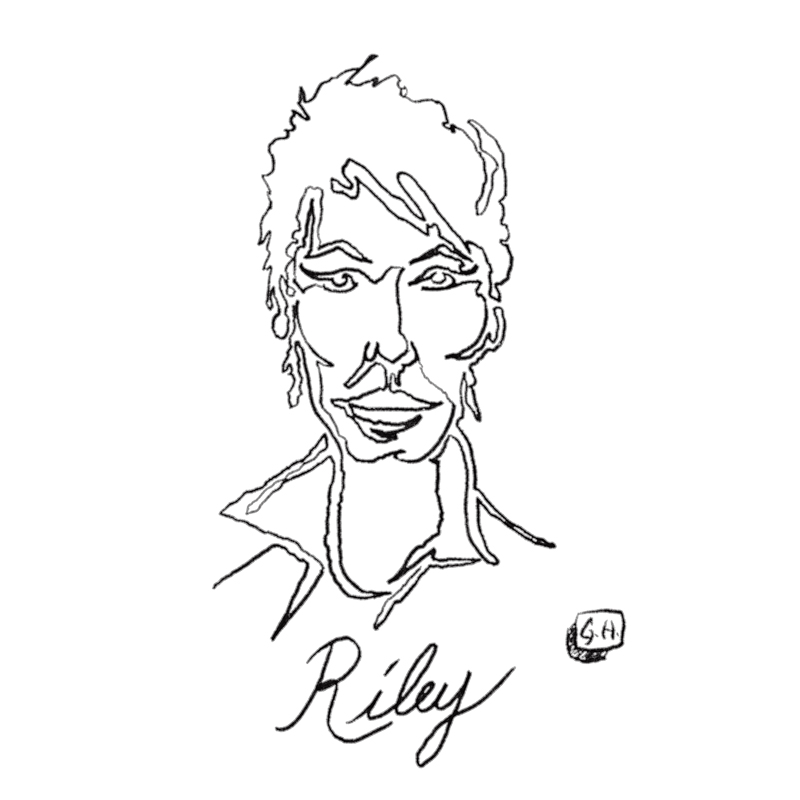
For a man with the widespread reputation as a happy-go-lucky stoner, the Boston singer-songwriter Riley James poignantly distilled the dark heart of humanity down to a few verses and choruses with impressive consistency. This hard-living, well-travelled artist penned some of the saddest songs known to North America, ones that were never quite ‘straight’ enough for mass appeal. Music business insiders however, at least those canny enough to recognize a kindred Kurtzian spirit, were simply entranced. Now, nobody claimed that James’s vocal style was technically perfect, but the fuzzy, warm growl he called singing was distinctive and he had a way of hitting the low notes that caused women to swoon and men to get angry.
A natural aversion to business dealings, typical of his kind really, worked strategically early in James’s career when he was consciously cultivating the ‘outsider’ image of an artist who wouldn’t be bought and sold like so many mocaccinos. Unfortunately, the result was that, for most of his recording career, despite a thoroughly honorable discography, Riley James didn’t have a hell of a lot to show financially for all his trouble. His irresponsibility had become a tiresome tic and he was unwelcome even in the offices of his final record label/microbrewery*.
Let’s back up a few years. Riley James’s eponymous self-produced début was good enough to attract the attention of major label publishers. Riley James featured short, sharp verses of hard-won pop wisdom in between jabbing choruses that left the listener wanting more. It seemed to come easy for him. The music press quickly fell in line, in the way they had years previously for Austin guitar-slinger Charlie Sexton, with whom James also shared a physical resemblance, insofar as they were both pretty, high-cheekboned, and full-lipped enough to be mistaken, at a distance, for women.
Expectations were high then for the sophomore album, Heathens & Heartbreakers. With a freshly inked publishing deal courtesy EMI Los Angeles (overseen by talent buyer Dean Frazier and VP Allen Barnett, who had started his career at ASCAP and wound up working for ‘the man’ just three years out of college), James swaggered into the studio swinging three solid AAA radio contenders. Even some of the ‘filler’ tracks represented serious possibilities for film and TV placement.
In order to reap greater benefits from what they thought was a sure-fire hit record, James and his manager Angie Bradshaw started their own label, also called Heathens & Heartbreakers, which they hoped would be distributed via CBS. This arrangement, minor league record company backed up by a major label publishing company, was practical and had provided many breakout artists with an avenue to success previously. But in the curious case of Riley James, it did not work and it remains a mystery as to why no-one could figure out how to put more than 50 people in room with James west of St. Louis, even as his third and fourth albums (Let It Slide and Happy Ain’t the Word), both critically lauded, stiffed.
Part of the blame, or perhaps all of it, must rest with Riley James himself. A good-looking boy, he had the motive and the opportunity and, put crudely, would simply not stop fucking anything that moved. This included his manager, and quite a few of her friends, with predictable complications and communication breakdowns. On the road, nights of oblivion and wanton sex caused no end of problems at a personal level (not to mention serial bouts of venereal disease), but ended up biting his career on the ass rather more seriously after an episode in Minneapolis when Riley hooked-up with the girlfriend of a regional AAA radio program director. Within days, sparked by the machinations of the cuckolded Twin Cities PD, a negative chain reaction among radio programmers up and down the Mississippi led to his fifth album, Dust In My Eyes, being all but removed from the Americana charts. This was particularly regrettable as Dust had recently been gathering momentum on the back of its strong title track (“Watchin’ you walk away/A part of me dies/No, I’m not cryin’/That’s just dust in my eyes”).
New managers came and went. On paper, it should have worked every time: Great albums, great production, unique sounds, chances taken with lyrics, and melodic surprises galore. Such was the regard for his musical gift, James never had trouble gathering a band or an engineer to make his mostly self-produced Lps. Yes, there were a few obvious musical allusions to past masters and the odd Beatles swipe, but who doesn’t steal the best from time to time (as James was fond of saying, “Like [The Beatles] never ripped anybody off.”)?
Despite the quality on offer, record sales were never a strong revenue stream. Nonetheless, Riley James managed to maintain deep pockets of dedicated fans. Boston and the Eastern Seaboard were basically in the bag, although he certainly didn’t help his cause by getting booted off an important Americana show in DC syndicated by NPR following an extremely hyper-active live broadcast. The show’s host, a devout Christian, convinced that James was coked up, sought to confront the singer backstage only to find him in flagrante delicto with a wily and willing female fan who had snuck in to the green room. Summarily dismissed, he waddled off the premises with his jeans around his ankles; it was both comical and pathetic. Word got around and James found himself temporarily banned from NPR nationwide.
It just wasn’t the same world out there for Riley James as it was for others. He was a man on a mission, and that mission was to get in trouble.
Once he moved to Nashville, where he had lived after following a pretty Three Faces Media intern there in 2016, his libidinous behavior only grew more depraved. For Riley, Nashville at this time was basically a pick ‘n’ mix orgy with a new crop of willing, experimental youngsters of every kind conveniently moving into town every day.
In interviews, he would smirk, but was sensible enough to be coy about his reputation; even so, he began attending 12-Step SLA (Sex & Love Addiction) meetings in an attempt to address the problem which had recently come to a particularly sordid head. James had been arrested during a sting operation at a swinger’s club that gathered in a duplex near Cinderella Studios, north of the Briley Parkway in Madison, Tennessee. In order to buy the duplex, the swinger’s club’s operators, Madison Lifestyle Hunters, had registered the property as “commercial,” which gave the district attorney a window in order to prosecute. It was a minor bust, and Riley James featured once again in The Tennessean; this time it wasn’t for a new album or selling out the Mercy Lounge, but for “illicit and immoral behavior performed in a public space.” Sometimes bad publicity is just bad publicity and with a seedy miasma now permanently cloaked around him, managers begun to give James a wide berth.
He started a final album using Pledge Music to raise the money for production. This time he decided to work with a producer and hired Jimmy “The Sandman” Rizzo who’d had some luck recently with a Gospel/Americana compilation called The Circle Remains Unbroken (Conscious Music, 2018). Rounder Records itself was interested in distributing the record, tentatively titled The Monster Under the Bed (Of the American Dream), but James had shtupped two of its reps five years previously (and left both under bad circumstances) and so once again scuppered the deal.
With his Pledge campaign, Riley James was careful not to over-extend himself, but decided to go a unique route and offer what he jokingly called “singing telegrams” for $250 a piece to those superfans who could afford it. The way it should have worked out was this: superfan (or husband/wife/partner of superfan) pledges $250 to Riley James’ new album, and when James was nearby for a show, he would schedule a time to show up at their house or office to sing a pre-determined song.
It was a great idea, but on the very first telegram delivery, just outside of Indianapolis, James showed up to sing his song “Lay It On Me” to a pledger’s wife and, caught up in the frisson of a virtually made-for-porn set-up, ended up attempting a quickie in the foyer of the family home. As if on cue, the husband showed up with their two young children, and pretty much witnessed the entire event, or at least its shuddering, sticky conclusion. Pledge Music, citing a morality clause in their contract, immediately broke off ties with James (and, of course, kept all of his money).
Finally, a bit of good fortune came James’s way when ‘Dust In My Eyes’ was placed in Disney+’s heartwarming Dog Day Afternoon prequel Puppy Morning. A surprize hit, the soundtrack album was streamed over 40 million times and because he owned the ‘Dust’ masters, James earned a small fortune, enough to retire comfortably. He took this jackpot as a chance to break the endless chain of one-night stands (in both senses) and quietly slink out of the scene while he could, to Florida.
Riley James occasionally performs at open mics in Boca Raton, where he also works part-time as a Pro Tools instructor at a local community college.
*The golden era of record-company-turned-adjunct-to-small-service-industry-oriented-business lasted a relatively short time (roughly 2012 to 2020). The likes of coffee bean roasteries and hemp clothing retailers, et al. soon found out they were dealing with a level of unpredictability and wilfulness greater than anything previously encountered. Returning to the normal shit storms associated with business (late orders, unsatisfied customers, sexually hostile work environments, etc.), they very quickly put behind them such ridiculous concepts as “SoundScan sheets”, “buzz clips”, and “artistic integrity”.
After blazing an unremarkable two-year trail as back-up guitar tech and weed procurer for Archers Of Loaf, Conrad Albee plopped into the thriving Americana scene with a self-released CD-R in early 2013. Garnering no little interest from gullible indie labels south of the Mason-Dixon line still looking for ‘the next R.E.M.’ after 30+ years of fruitless effort, Albee’s Born On Interstate 40 actually contained two worthwhile songs, “Between The Mountains & The Moon” and “Down On The Piedmont”. The rest of the disc was a clever mixture, lyrically and musically, of early-period Ryan Adams and late-period Ryan Adams, with some mid-period Ryan Adams thrown in to keep it fresh.
The more kindly music writers called Albee’s craft “somewhat familiar” and “perhaps over-familiar”, while others went with “not gonna lie, really fucking familiar.” But Albee made no bones or apologies about it, almost gleefully admitting to having copped everything he could from a certain Jacksonville, NC singer/songwriter. “At least I didn’t rip-off Bryan Adams!” he would joke onstage at literally every gig he played, which never got old. Not a bit.
An obvious, clickbait-y Kickstarter campaign employing copyrighted Getty Images photos of old sunburst Gibson guitars and down-home, sepia-toned rural scenes cut-and-pasted from other crowdfunded projects (plus a clear bump from the surreptitious and unauthorized use of Archers of Loaf’s mailing list) somehow managed to net Albee nearly $60k. Like bees to honey or, indeed, flies to shit, Albee’s windfall attracted a teeming, greedy array of low-rent Nashville publicists, song pitchers, and publishers who all came for a sniff of the soon-to-be-forgotten singer’s money. Alas, this is an unfortunate, but all-too-common scenario in the music business of modern times. And past times.
Extravagantly praised by Whiskeytowncrier.com’s lone music critic Chris Reed as “sonically uninteresting and highly derivative”, the re-recorded, re-released Born (Again) On Interstate 40 (Kudzu Records) was but one of a remarkable thousands-strong glut of Americana releases that came out in 2014. Unfortunately for Albee, major retail chain See De’ Baby refused to carry it until a plagiarism lawsuit brought by Ryan Adams was settled. Adams dropped the court case in fairly short order when it was revealed that not one Interstate 40 cd had been sold, but defending the case wiped out the last of Albee’s remaining Kickstarter bonanza. The album was never released on vinyl, nor will it.
A scant two years after his record came out, Conrad Albee moved back to Statesboro and, oblivious to the heavy hand of irony, took an assistant manager’s job at his father’s Kinko’s franchise, finally earning money by making copies for a living.
And he still listens to Ryan Adams, you know, despite everything.




 Americana Unsung