
Perhaps her parents’ literary joke was just too tempting for the Fates, but in christening their daughter Francis, thereby making her full name a near homophone of the title character in a particularly tragic Ernest Hemingway short story, they effectively cursed her short, unhappy life. Nonetheless, Francis McCombe’s music remains ripe for discovery by the greater public, but not before her gossamer legacy, a trove of rough demos, has been sifted through, thoroughly re-mixed, and tenderly edited.
Her parents, Glenn and Marta McCombe, were both Anthropology professors at North Carolina State, who also happened to be folk musicians with a penchant for over-indulgence in whiskey and marijuana. They sang Bolivian Folk Songs to her while she was in the crib. “Puedes Ser Qualquier Cosa” (You Can Be Anything), an inspirational tune about a coffee farmer who longed for life as a sailor even though he lived in a land locked country, was a particular favorite. Much later she would sing it in public, at parties or guitar pulls, giving her an air of international intrigue, even thought she had never been father south than Tallahassee.
At least initially, there was a lot of fun around the McCombe’s house, but also, perhaps not coincidentally, a lot of alcoholism. Glenn and Marta hot-housed Francis with what they assumed was a well-rounded education, but in reality left her under-socialized and over-medicated. Her folks split up when she was seventeen, amid bitter recriminations and mutual allegations of domestic violence and substance abuse. In the divorce settlement, McCombe somehow ended up with her father’s precious 1962 Gibson Hummingbird. She named the guitar ‘Emmylou’ and in all the desperate, tragic times that followed, Francis never allowed anything to come between her and Emmylou; alas, the guitar represented the only part of herself she allowed herself to treasure. And so Emmylou was always polished, always set up properly, always in tune, always kept safe in its hard shell case, and, remarkably, never pawned.
She attended North Carolina State shortly after but soon dropped out, the pull of Nashville, a geographical magnet for the budding musician. McCombe worked a job at Five Points Pizza for a season and did a stint as a bartender Robert’s Western World. She soon took to spiralling in and out of doomed relationships, and then, as she followed her parents footpath, in an out of rehab. She simply could not stay sober, however dire her circumstances became, wracking up two DUIs in one year. Eventually, Musicares refused to offer her a bed at one of the dozen or so clinics within a few hours of Nashville and she resorted to couch surfing. Despite her obvious talent, club owners barred McCombe from their tribute nights on account of her habit of draining all the bottles backstage. She lived like a lost cause.
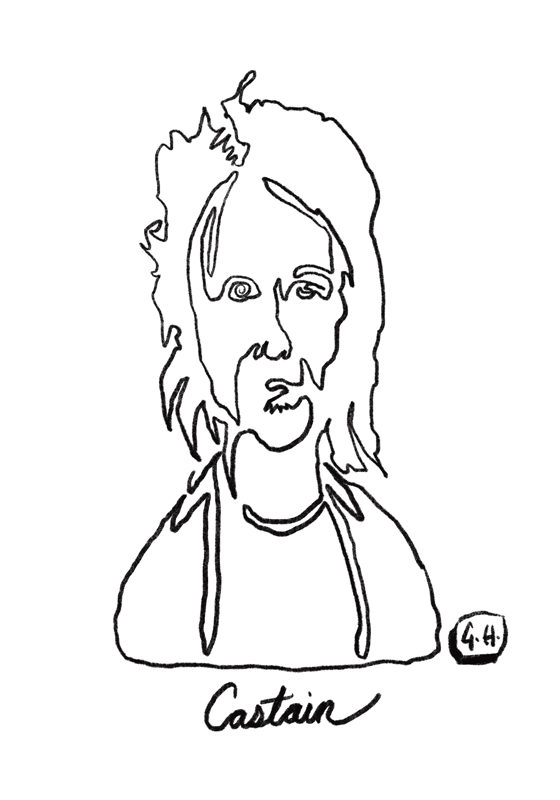
Francis McCombe had the terrible misfortune to grow up beautiful. Her long, lank dirty blond hair, sun bleached freckles, and eccentric thrift store fashion choices caught the eyes of the men and women all across town. Married to this tragic beauty was a sharp tongue and a contagious laugh (nearly masking her smoker’s cough) that drew in just the wrong sort of co-dependent type looking for someone to ‘complete’ them. Many an East Side musician considered that maybe, just maybe, he was the one who had what it took to capture her and her songs, to arrest her untamed spirit. This proved impossible. Her sad and lonesome eyes entranced dozens, but they all abandoned her. Time spent with Francis McCombe was nothing to write home about, even as it was something to write a song about.
In fact, the “Carolina Cobra” (a nickname she earned on account of her ability to wrap her lips around a full can of beer, kick her head back, and proceed to empty it in one go) was a prepossessing songwriter, especially considering her tender age, with a knack for lyrical inventiveness and memorable choruses. However, she often struggled to resolve a story line, so for all their insight and emotion, many remain more impressionistic, narcotic snapshots of relationships than fully realized songs. She was certainly able to bend a few ears at local open mic nights and ‘In The Rounds’ around town. However, McCombe spine curled when it came to ambition, direction, or gumption.
After numerous false starts with countless “producers”, i.e. fellow struggling singer-songwriters with semi-professional rigs in their cramped East Nashville apartments, McCombe had amassed dozens of recordings on a variety of formats (analogue tape, Pro-Tools, Logic, Radar, Garageband, iPhone voice messages—so many thumb drives in her purse) in various stages of completion. Though only a few of her recordings were blessed with truly finished vocals, and several feature scratch takes replete with sheepish apologies and audio verité groans and sighs, it would take a hard-hearted critic to deny that these demos captured something special, however inchoate. Unfortunately, McCombe would usually chain smoke marijuana during her recording sessions, making it difficult for her to retain focus and trying the patience of both musicians and engineers. By the end, she simply exhausted, in one way and another, each of the benefactors who attempted to help her assemble an album in some form.
A chance encounter with the locally infamous Americana scenester Junebug Jonez, who was deep into a warm and merciless heroin abyss, left her strung out within weeks. He also got her pregnant. Unable to get clean herself and sensing that an end was near, Francis set to rescuing as many fellow addicts as she could, lecturing them, pleading with them, citing herself as an example, and even, at great personal peril, flushing one dealer’s considerable stash down the toilet. At least three users credit McCombe with saving their lives. Less than a month after walking out of yet another rehabilitation facility, Francis took herself out of the game by doing two “Gram Bongs” (a shot of tequila followed by an arm full of morphine) within a 12-hour period. That she was now a member of the ’27 Club’ became a talking point, and no one was certain if her death was intentional or not.
For a short time after she died, a few of her local devotees would attempt to sing “Dark Alleys,” McCombe’s most popular song and the only one released in her lifetime*. Performing it around backyard campfires and living rooms, the opening line, “Bang me big hammer like it’s the first day of the war,” always provoked nervous laughter among those gathered.
Her mother, with whom she had remained close throughout all the ups and mostly downs, had her body cremated and scattered over a beach outside Cape Fear, a favorite place from childhood.
*On the NPR compilation album Folkscene (2015); it actually received a few spins on WMOT, garnering a small cult of admirers.
 Americana Unsung