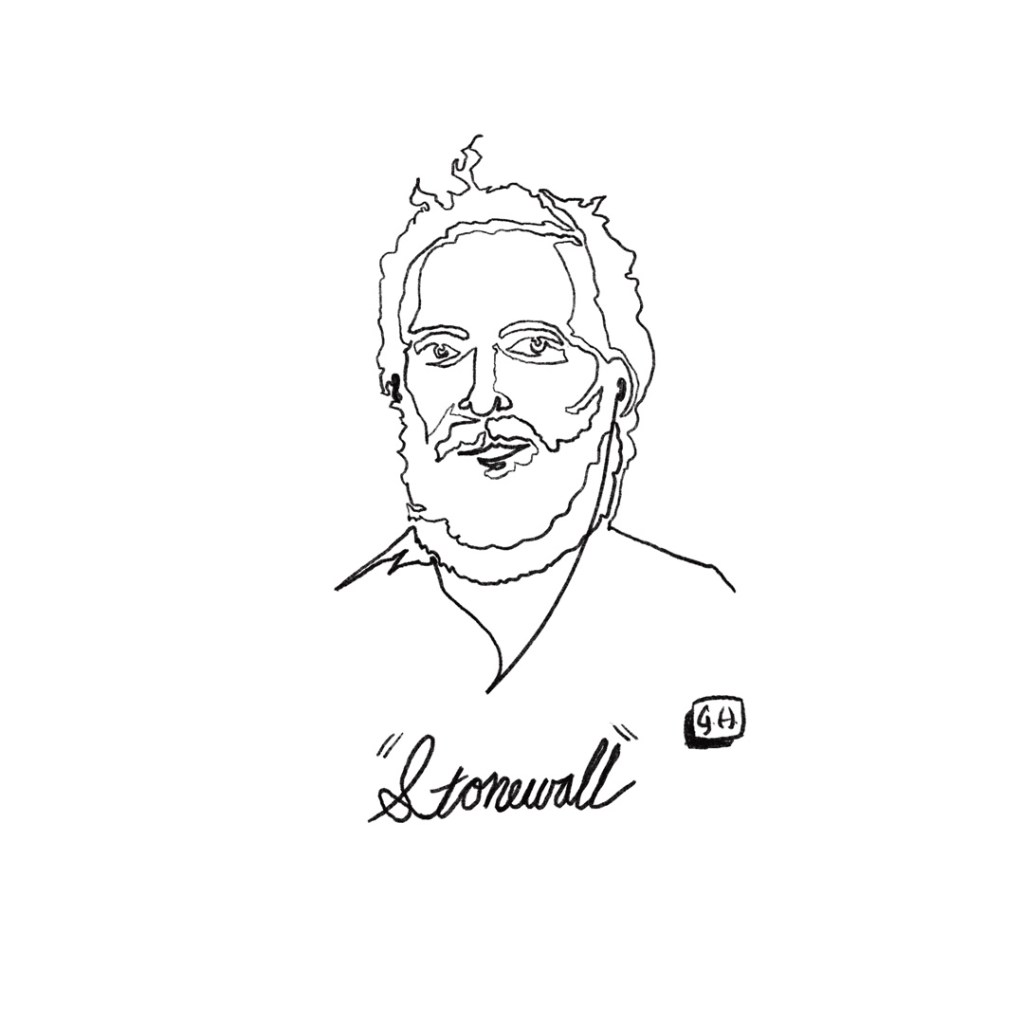
Georgia’s Stone Mountain’s infamous laser show is one of the most fascinating and disturbing uses of light amplification by stimulated emission of radiation technology to honor men on the wrong side of history. The program starts off, harmlessly enough, with the lasers rendering a full portrait of Ray Charles as his exquisite rendition of Hoagy Carmichael’s tribute to the Peach State plays over the speakers stretching across the massive field in front of the mountain. The next sequence is more troubling. Lasers ‘finish’ the world’s largest pro-inequity bas-relief monument by ‘drawing’ legs on the torsos of the horses underneath the 190-foot wide rock depiction of Robert E. Lee, Jefferson Davis, and Thomas “Stonewall” Jackson. Thus animated, the lasers then heroically ‘march’ the Rebel leaders off the side of the mountain, as “Dixie” blares from the PA system.
One night back in ’88 as the Pink Floyd-esque version of General Jackson marched off the mountain to that Yankee-written Confederate anthem, Hank Jackson, completely loose on the handful of mushrooms that his girlfriend, Sadie Mae Buckley, had supplied, swore that the old general looked him straight in the eye and uttered the words, “I command you to make me a son.”
As cheers rose up from the crowd, the couple wandered off to the nearby woods. Putting strange psychedelic experiences aside, the University of Georgia computer science major took his partner of only four months out into the bushes to do what college kids will do.
Hank Jackson was not a racist man, and unlike many of his Polo wearing Fraternity Brothers, he was quick to shut down any racist comments within earshot. But he came from a Southern family that had distant relatives who had fought for the South in the Civil War, and some not-too-distant relatives who may or may not have gathered in Klan robes at the foot of Stone Mountain in the early part of the 1900s. He was another example of a boy who grew up with actual Klan members in his family, but was able to break the chain of hatred through the love and education of good parenting.
Despite this, Hank Jackson chose for the son conceived that night an unfortunate and ill-judged middle name. Still reeling the next morning, he promised the spirit of the notoriously stubborn rebel General who was accidentally shot and killed by his own men at the Battle Of Chancellorsville to name his son in “Stonewall”‘s honor. Nine months later, as he wrote ‘Moses Stonewall Jackson’ on the birth certificate, Hank had apparently not reconsidered; whether it was mischief making or something more profound at that point, we’ll never know.
Moses Stonewall Jackson was sensitive enough to dislike being called by his middle name. He has since been called plenty other things: poet, picker, magician, workaholic, vandal, vagabond street musician, and respected songwriter. Jackson has also been known as a bush pilot, an Alaskan recluse, and founding member of the renegade activist organization Wander The Woods. These days, he is a prophet or a terrorist, depending on which side of the political coin you toss. Either way, there can be no doubt that he is the greatest overachiever in the contemporary Americana scene.
After growing up in the furiously independent and artistic Athens, Georgia music and art scene, Moses, who managed to keep his middle name out of the press for as long as he could, ended up becoming a prolific and talented creative. His parents, who remained in Athens after finishing college, opened a coffee shop and proceeded to curate one of the finest vinyl record collections in town; which you could peruse and spin at their shop.
Moses started writing songs early; creating “albums” of cassette recordings he had made at home using his parent’s stereo. In his earliest days as a budding songwriter, Jackson’s modus operandi was to write a bunch of titles and then just write songs to go with them. These cassettes have so far never been released, but somewhere is a plastic tote full of these early, inchoate projects. Before Jackson had finished high school he had actually released his first album, Another Creek Bank (2007), under the name Bright & Broken. The record came out on vinyl-only (of course) thanks to some like-minded friends in the Platypus Seven Collective that had also released albums by The Broken Bridges, On My Bastard Knees, and other local singer-songwriters who hid behind band names, as was the fad at that time. No legal documents were ever signed, with the understanding that creativity was not to be stunted in any way through contractual tombstones.
After his début seeped out, Moses Jackson did not hang around for any public acknowledgement. Instead, he bolted on a backpacking trip to Europe where he busked streets from Dublin to Barcelona, oblivious to the gathering tide of praise back home. Another Creek Bank started to get passed around college radio, who never waited for someone to tell them if something was relevant or not.
Meanwhile, through various college connections and tech savvy music geeks, the internet started to buzz about Moses Jackson. Not much was known about him, which added to the allure, and soon ‘genius’ rumors began circulating.
Pitchfork sang hosannas, saying Jackson’s songwriting “…heralds a new form, where lyrical explosions match the sonic surprises.” The word eventually wung its way across the Atlantic to Madrid, where Jackson had taken up residence at Casa del Musica Acoustica, a folk and jazz club that paid him in hashish and Paella.
Clearly en route to major independent labels and such, Jackson returned to North America to assemble a band that went on to tour the Continental US in a Black conversion van he christened the “Sweet Black Angel,” after the Rolling Stones’ 1972 tribute to political activist Angela Davis; he immediately wrote and recorded “The Ballad Of The Sweet Black Angel,” an ‘aw-shucks’ tale of North American van life. He went on to woo both coasts, not to mention the heartland, before getting dropped by 3 different managers and as many booking agents and publicists simply because he could not stay in the present and support the album he was ostensibly touring.
The sleeve of the first full-length album under his own name, Moses Jackson Destroys The Past (2008), featured a picture of the cherubic singer on the front with naturally messy hair tucked underneath a Greek fisherman’s hat with his big, youthful, optimistic eyes on full display. It was an instant hit with college DJs. He had the proverbial old soul, and in the face of the widespread cynicism that came with the punk rock ethos still rampant in indie music, there was an idealistic force to the lyrics so forcefully belted out on top of all of the nihilism that the music may have implied. Drums machines, horns, samples–there was nothing off limits, and Jackson was not lacking in confidence when it came to singing, something that went against the grain of the mumbly, echo and reverb soaked vocals that were taking place around the edges of incoherent vocals and weak lyrics scenes that flourished in post-REM Athens. With the advent of cheap synths and reverb units, combined with remarkable sampler technology, Jackson went against that particular grain with thoughtful, enunciated lyrics; nobody had to guess what words he was singing. Even if they did not appear to form a cohesive story, you could tell he was actually reading literature.
The problem, if you want to call it that—and anybody other than Prince trying to make a dent in the music business would—was that Jackson was simply unable to cease creativity long enough for the public to catch on to any single composition. By the time he reached the West Coast on his first tour, backed by a trio of worthy musicians from Athens, he had composed an entire new album’s worth of tracks. To make matters better or worse, he also not only assembled demos of these tunes through late night workaholic sessions in Red Roof Inns across the nation, but he also insisted the band play the songs live. The “old” songs already felt rusty to him, and there was a new vibe around every corner. As the band progressed up the West coast, they popped into Jackpot Recording Studio, owned and operated by Larry Crane, who also ran Tape Op magazine, and who had recorded a young Elliott Smith, a hero of Jackson’s. During a one day marathon session, the band recorded 13 new songs, 9 of which made it to his second album There Is Another Way, the rights to which he promptly signed over to the Olympia, Washington indie label Kill Rock Stars before the mixes were even done. With the promise that they would print and release the vinyl within three months of that date, and of course pay the studio bill. This time there was an actual contract, but nobody actually read it.
The word was out. There was another superstar on the rise, and the critics and the super fans came crawling. The major labels did too, but were sent packing after they realized that, as John Lee Hooker had famously done years before, Moses Jackson was constitutionally incapable to fully comply with or understand the subtleties or basic realities of a legal document, and would record and release albums willy-nilly, at a frightening pace, whenever and wherever he could. So for example, only two days after signing the Kill Rock Stars contract, Jackson recorded two songs at the apartment of songwriter Pete Krebs in Portland, which he then sent via cassette to the ultra-indie Okra Records, based in Columbus, Ohio, who promptly printed them into a 7 inch record. Two days after that session, while in Seattle, Jackson visited the offices of Sub Pop records where he verbally agreed to a project that never came to fruition after Kill Rock Stars label owner Slim Moon, in possession of the still wet, yet somehow meaningless contract, called Jonathan Poneman of Sub Pop and explained what was transpiring with the explosively creative troubadour.
Friends and casual acquaintances all tried to sit Jackson down and explain how lawyers and contracts worked but it was going in one ear and out the other. Both ears, incidentally, were often covered by headphones, as he was constantly listening to or working on demos. He was on a mission to sabotage the norms of creative output, and then he finally met his match, or his spark, so to speak.
The weekend following the sessions for the Kill Rock Stars LP, the band played two shows in Seattle. Jackson met a young poet and visual artist named Stormy Vanderark from Palmer, Alaska. Stormy was to alter his path considerably. The band was set to drive back to Georgia when Jackson suddenly decided to not go with them and instead follow his new friend up to Alaska where she had promised him a unique adventure. The two of them, along with a young Malamute dog named Huckleberry Funn, crossed the Canadian border in her Subaru Outback and made their way through the Yukon and into the Matanuska Valley, falling deeply in love along the way.
Once in Alaska, the Vanderark family fascinated Jackson. Stormy’s father Cyrus was a deeply Christian master carpenter, while her mother Rosetta was a superior woodworker, who also created sculptures out of found objects. Rosetta Vanderark reminded Jackson of his own maternal grandfather, Henry Moses Buckley Sr, a Vietnam Vet who welded sculptures out of old car parts and created art that filled his two acre lot just outside Leipers Fork, Tennessee; he had once hosted the songwriter Leonard Cohen for three days of Transcendental Meditation, Yoga studies, and welding lessons. The Vanderark compound, in the village of Sutton, just outside of Palmer, Alaska had 360-degree views of the Chugach and Talkeetna Mountain ranges. They were also just a short drive from Hatcher Pass, a glorious passage through the Chugach range that appeared to be right out of a Tolkien novel. In fact, the whole Vanderark vibe was one of creativity and art from the way their house was built, their garden, the animals, the magnificent mangers they built for the animals, and the constant push towards self-expression and radical gardening. They made their own clothes, and they made their own music, heavily steeped in denim, corduroy, and old-timey folk tunes respectively.
He and his new love were creating together as well. He worked on lyrics and songs, and she worked on designs for merchandise such as shirts and bags and necklaces made out of old guitar strings and stones from the creek. The Vanderarks had plenty of room and use for a new able bodied man around the compound, and Jackson learned the art of macrobiotic cooking and doing hinterland chores such as chopping wood, Northern climate farming practices, and feeding the horses and goats.
Jackson stayed on as long as his restless mind could handle, but as the winter 2009 approached he decided to part ways and returned south for Christmas in order to tend to a few personal items such as attempting to pay his bills and also to resume communication with his own family, who had grown somewhat concerned with his radio silence. He was, after all, spending time in a place where cell phone service wasn’t reliable, and nobody cared about posting photos of their latest meal (which, in no way possible, was as good as the fresh Alaskan Salmon, Moose, and Caribou meat that Jackson was enjoying in the North).
Once back home, Jackson grew increasingly irritated with his old, slow moving creative community and their absolute reliance on social media. Jackson himself had been highly addicted, posting regularly on Instagram, Twitter, and other creative hubs. He was known for chronic over-posting, further driving independent record distributors insane with his constant flow of new music, often posting songs the day he wrote them, without much thought or editing; they would garner thousands of hits right on the very week that Jackson had released an album that distributors were trying to sell at media outlets. A lot of hair was pulled out but what could they really do?
The advent of the Tik-Tok fad was one login password too many for Jackson, and he famously tossed his iPhone out of the window of a moving van as it crossed over an interstate bridge outside of Atlanta. His new bandmates just laughed at his recklessness, but then that same night, when they were set to headline a high-paying New Year’s Eve gig at a private farm in Douglasville, they were unable to communicate with their lead singer, who had wandered off into the woods when he was supposed to be on stage.
This was just too much for his backing group, pulled together from among the few remaining Athens musicians who either didn’t want to kill Jackson or steal his gear to help pay themselves from past tours. When they encountered him a few weeks later, he was unceremoniously chewed out for his foolishness and inconsideration. He copped to it, admitting that he had met “a new friend” who drove him off in the night. Moses Jackson was due for a reckoning, and it came in the form of his band mates and flatmates unceremoniously kicking him out of their shared house. He was not welcome in Athens for a period of time, and although there was always some sad eyed lady of the lowlands or other who would take him in, he grew evermore nonchalant about all things related to his career and social media, and so one day without warning he hit the road for Alaska again.
Arriving in Spring and promptly showing up at the Vanderarks’ door, nobody batted an eye as they welcomed him back into the fold. Stormy, who was more independent than any woman he had ever met, cared less about what he had done in her absence, and more about what he was going to do now that he was back. In her opinion, humans were free to act as they wished as long as they could handle the consequences, something that Jackson was slow to pick up on.
Before long, the two of them had begun work in building their own cabin on the property of the Vanderarks. By mid-Summer 2010, Jackson had home recorded enough tunes on a cassette four track to print another album. Backing vocals were provided by the Vanderark Family and the songs took John Prine’s old maxim of “blow up your TV, move to the country,” etc… to a new level. Jackson named the project The Valley Below. These were folk songs about destroying Social Media and all or anything related to the old South, but sung with a folksy, family band vibe. One of the songs, “Dead And Gone,” a scathing report on all the sculptures of Nathan Bedford Forrest that dotted the American South, featured the lyrics:
“If you vote to keep Nathan’s sculpture in your Statehouse capitol/we will hunt you down, and put you in the ground.”
This was Woody Guthrie and Phil Ochs on steroids, and when the press got wind of the lyrics they immediately focused on Jackson’s given middle name, causing him enormous amounts of embarrassment. The press also quoted, and deliberately misinterpreted, the controversial lyrics to both “Sweet Black Angel” and “The Ballad of….” In his over-sensitive and defensive mind, he had no option but to answer his critics (now mostly bloggers since major websites such as Pitchfork had ignored him with every project since There Is Another Way.) with another song cycle that attacked the three figures of the Stone Mountain monument, and especially his namesake.
This time, any label with actual distribution was out of the question. These new projects were completely independent and released on Bandcamp only. Jackson claimed he didn’t want to press vinyl because of the environmental damage that vinyl manufacturing houses were causing, but the fact is he couldn’t get anybody to print the vinyl. The majority of the merchandise was based on fashion and poster art created by Jackson and Stormy Vanderark. A very small vanity label from the region, Hatcher Pass Records, started by the songwriter Matt Hopper, offered to press vinyl for one of the four albums Jackson made while studying for his bush pilot’s license that year. Jackson conceded because the pressing was to be very small, only 250 copies, and they would hand paint each and every one of the covers, all using recycled Lp jackets they bought in an Anchorage Salvation Army Thrift Store. Unfortunately, Hopper and Jackson’s relationship soured after Jackson released the Bandcamp only Lp Trustworthy Pilot (2012) on the same day as Hatcher Pass released The Value Of Your Word (2012) on vinyl. Both albums were praised by Guided By Voices frontman Robert Pollard, who surely recognized a kindred spirit in his prolific fellow creative soul.
Already an outsider, Jackson became estranged from even independent society. He was literally out on the fringes of small town Alaska. The lack of sunlight and daily ingestion of THC infused gummies had an impact on the normally hyper-creative Jackson. He found himself unwelcome at house concerts and songwriter nights in Anchorage; his beloved Stormy could not slap him out of his self-centered rants. He began to read more and write less. He read all the words and journals of Edward Abbey and Che Guevara, the El Salvadoran poet Roque Dalton, The Unabomber’s Manifesto, and plenty of other anti-establishment literature. He began to feel there was no way forward for his thoughts on social media and began to lose followers by the hundreds due to his increasingly violence-stoking rants about burning down the system and starting over again.
He would wander into Vagabond Blues, a coffee shop and folk listening room in nearby Palmer, where he would obsess over the internet–his only connection to independent music being made in the lower 48. He would often post a dozen or so consecutive rants on various sites. He began hash tagging his rapid-fire posts #WanderTheWoods or #TheQuietPath. Jackson would spit vitriolic responses to anybody who compared him to Christopher McCandless—the romantic and very much dead wanderer who became a hero because of the book and film Into The Wild (2007) which documented his nomadic descent into tragedy. “That idiot went out into the woods and died,” Jackson was known to say. “I can actually read maps and understand how rivers work,” he would taunt those that considered McCandless a hero.
Within a year of his arrival to Alaska he had burned too many bridges to count and was forced to move into a cabin in Moose Pass, on the Kenai Peninsula. From there, he began to make the plans that would shock and enthral the nation, earn him countless new admirers, and not a few enemies, and propel him to a whole new level of folk stardom.
Unbeknownst to the Vanderarks or most of his family back in Georgia, Jackson hatched a two-fork attack plan in regards to destroying or defacing Confederate Monuments. His first attack was simple and direct. He schemed to vandalize the statue of Nathan Bedford Forest that lays on a patch of private land just off Interstate 65 as you drive North into Nashville. There was a fever in the land among racists with the re-election of the nation’s first black president, and during the same period, the group, which by now was off the internet completely and only relying on hand-written letters, hatched a plan to drop as many gallons of pink and black paint as they could carry onto the very relief sculpture that gave Moses Stonewall Jackson his middle name. Unfortunately, the FBI, who had been monitoring Jackson for several months at this point, foiled his plans at zero hour, apprehending three of the four vandals as they attempted to ascend Stone Mountain with rappelling ropes and plastic containers of paint.
Jackson got away, however, and retreated to Alaska. None of the three apprehended vandals gave up his whereabouts and all were released due to no prior convictions. The Vanderarks refused to let him back on their land. It was not because they disagreed with his political stance. They simply did not want the press or, worse, copycat radicals to seek him out there. Some say he has moved to Idaho, and others say he returned to Tennessee. Either way, the most common speculation, based on his own manifesto, published before closing all his social media accounts, and the thing that got the FBI to monitor him in the first place, is that Jackson is currently part of a small, off-the-grid communal farm where members are forbidden to have smart phones. There is further speculation that Jackson has renamed his group The Way, or The Quiet Path.
Wander The Woods was taken off the FBI list of terrorist organizations since no further evidence was brought forth regarding their activities since August 2012. Meantime, in the public forum over the next seven years, most people agreed that the Stone Mountain relief should be altered in some way to put the sculpture in historical context, as opposed to a glorification of Civil War traitorousness. But because of a short national attention span, fear, bad-faith governance, and social media, the matter of just what to do about the disgraceful monument has never been resolved.
As of today, the largest shrine to White Supremacy on earth is still there, waiting.

 Americana Unsung
One reply on “Moses Stonewall Jackson”
That’s quite a yarn you’ve spun there Mr. Edward.
LikeLike